Reflecting On Reflections–the stories inside the shine


I love things that shine, sparkle, or shimmer, just because they are beautiful. I also love anything that holds secrets or points beyond itself. Some things, in reflecting light, do both.
Recently I was fascinated by the way people incorporate drawings of cabochon-cut gems into Zentangle-inspired art. Cabochons are rounded and polished, not faceted, like smooth blobs of glass. In looking at demos of how to draw them, I was puzzled by the white highlight. Should the white spot be round, or a long bar? Where should it be placed? I looked at photos of cabochon-cut gems, using Google images (so useful for things like this!), trying to figure out how the bright spot works. In the photos, I saw reflections in the gems of… their light source.
Purple cabochon gem with reflected window.
Gem reflects window and potted plant.
Duh!
Some bright spots were shaped like windows, some like bars of overhead fluorescents, while others were merely a round bright spot (an incandescent bulb? the sun?). And sometimes there were multiple bright spots, because there were multiple sources of light.
But it wasn’t just the light source that I saw reflected in the gems. Was that the camera apparatus making the dark square shape? And the shop where this other photo was taken must have a whole bank of windows. In one gem, I even saw the silhouette of person sitting nearby.
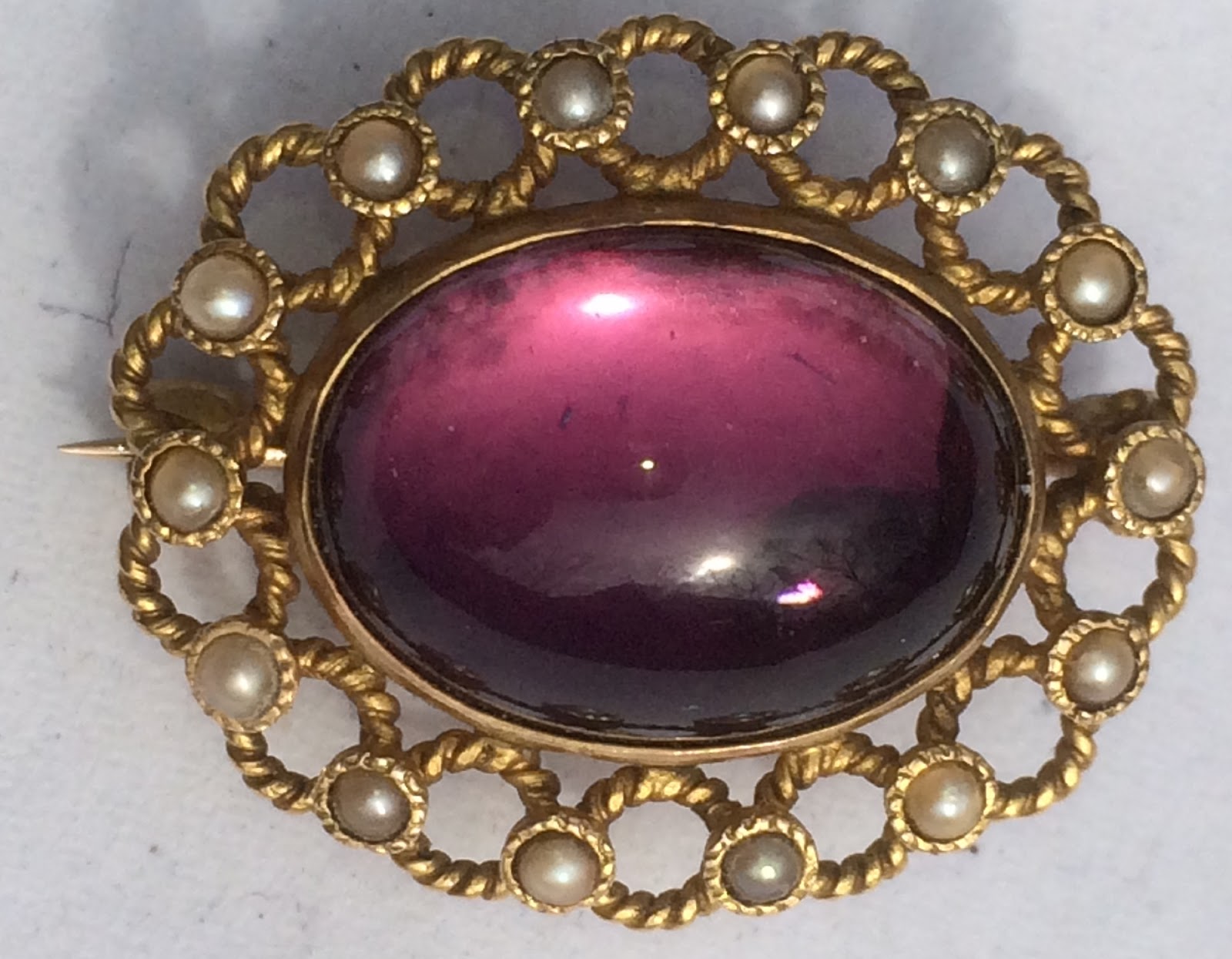
Purple cabochon brooch with reflected trees.
Outdoors, you can vaguely see the trees as well as sky.
In each case, all I was looking at was a photo of a single gem, but the reflections told me more.
This shouldn’t have been news–we have mirrors in our cars precisely to give us information about things out of our line of sight. Reflections sometimes play a role in stories, too. I remember an Ellery Queen mystery (the TV series) where the lack of a reflection, where one was expected, revealed something important. And in Bladerunner, a reflection in a photo gives the detective a clue (at least, I think it was a reflection—it wasn’t entirely clear in the movie). A painting that includes something shiny, such as a silver teapot, might make a good clue in a mystery novel– the distorted reflection of a face could reveal that a third person had been present at the sitting and perhaps even who it was (by their distinctive hat, say).
Silver teapot with reflection of kitchen including two jars of peanut butter.
What kind of peanut butter do we buy? Two jars worth.
Reflections also show up in mysteries because of the misleading way they reverse the appearance of what they show. Someone who sees something in a mirror sees it reversed—information, and yet misinformation.
For the most part, shiny things are appealing because of the way that they play with the light, not because of what their reflections tell us. In fact, paying too much attention to the reflections in gems rather takes away from their immediate appeal. But I like knowing that if I want, I can see more than just the gem. I can see the world around it.

Till next post.

Purple cabochon brooch with reflection of two fingers.

Books, Nostalgia, and Death


Warning: the following post might get a little depressing, but I’ve tried to end on a positive note.
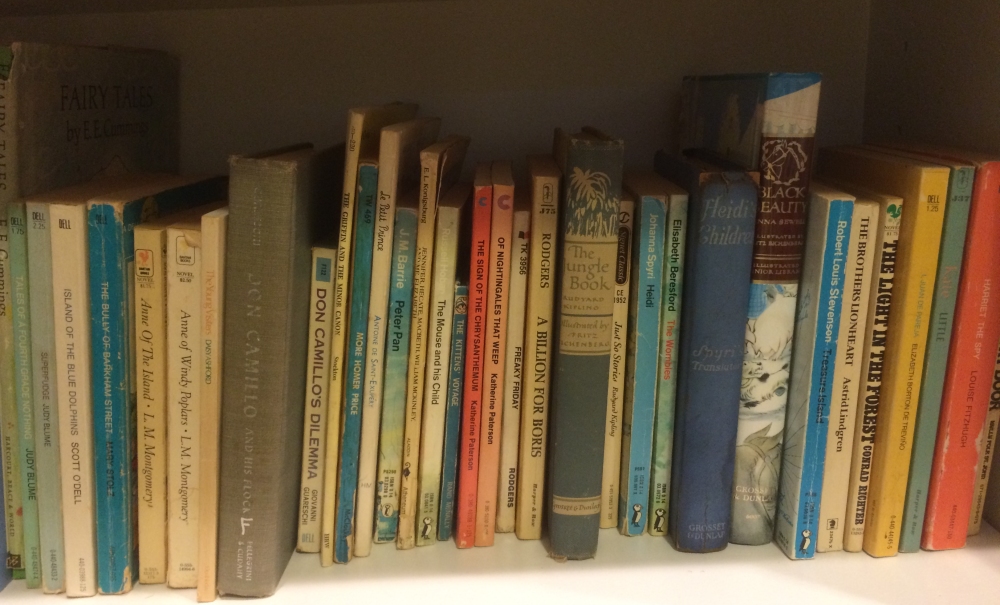
I’ve been sorting through my books this week, shelf by shelf. I lay them in rows on the floor, dust the shelf, and replace only the ones I really want to keep. That’s most of them, but I have so many shelves that I’ve managed to pile up a sizable stack for the  library nonetheless.
As I lay them out, I’m reminded of when I read them. The Deryni books? That was college. Piers Anthony and Anne McCaffrey? Mostly high school. Laura Ingalls Wilder? My mom read Little House in the Big Woods to me in first grade, and we went on from there. She still remembers the night we read the chapter “Fever and Ague” and stayed up really late to finish it.
Some of these books I read to my daughter when she was young enough to want to be read to: The Book of Three, Understood Betsy, The Westing Game. Some I got on audiobook so we could share them on long car trips: The Trumpet of the Swan, Bagthorpes Unlimited, Little Women. But a lot of the books I enjoyed growing up, especially the ones I read after age ten or so, she was never interested in reading.
I feel sad as I look at the lines of books on the floor, thinking of the time I spent repeatedly re-reading certain books and knowing that I will probably never read them again nor find someone else with whom to share them. They were important to me at the time, but there are lots of new books that are also good and worth reading, so except for the very best ones (and these are the ones I continue to re-read: Watership Down, Lord of the Rings, Peter Pan) it isn’t worth trying to talk anyone into reading them.
I can’t let go of them either, though, so there they sit on the shelf—the Gemma books by Noel Streatfield, the Prydain books by Lloyd Alexander (battered from much love), C. Dale Brittain’s A Bad Spell in Yurt (actually, I suddenly want to reread that one), and so many more. Do people even read Where a Red Fern Grows any more?
So I look at these rows of books that are slowly growing outdated, or at any rate forgotten, and I realize that as the world’s supply of good books continues to grow, almost all books face this fate. Books, like people, have a limited lifespan, with some living much longer than others but none forever. Just as some day I will be gone, the books that helped make me who I am will some day no longer be read—and that includes any books I might myself contribute to the current supply.
That thought is rather depressing, so here’s the attempt at a positive spin. Just as these books helped make me who I am, they also influenced the authors of the subsequent generations of books. Their effects live on beyond themselves, as I hope my own influence will.
And if that isn’t good enough, try this. There are some really great books out there—more than enough for a lifetime. You don’t have to read them all to be glad they exist.
Till next post.