NaNoWriMo 2018 and a Celebration of Spiral Notebooks

Once again, I am planning to participate in NaNoWriMo—National Novel Writing Month. I will attempt to write a 50,000 word novel—beginning, middle, and end—starting on November 1st  and finishing by the end of day on November 30th. Obviously, even if I finish, it’s going to be a pretty lousy novel. But that’s what first drafts are for.
I’ve been doing NaNoWriMo for years now. Some years, I finish in time. Some years, I finish the novel but not until February. Some years, I get hopelessly stuck in plot problems and never finish.
I really like the excitement of starting a new project, and a new project requires a new notebook. While I do type the novel (much easier to keep track of wordcount that way), I also write notes, timelines, and sometimes bits of text in a spiral notebook that I’ve picked out for that year’s project.
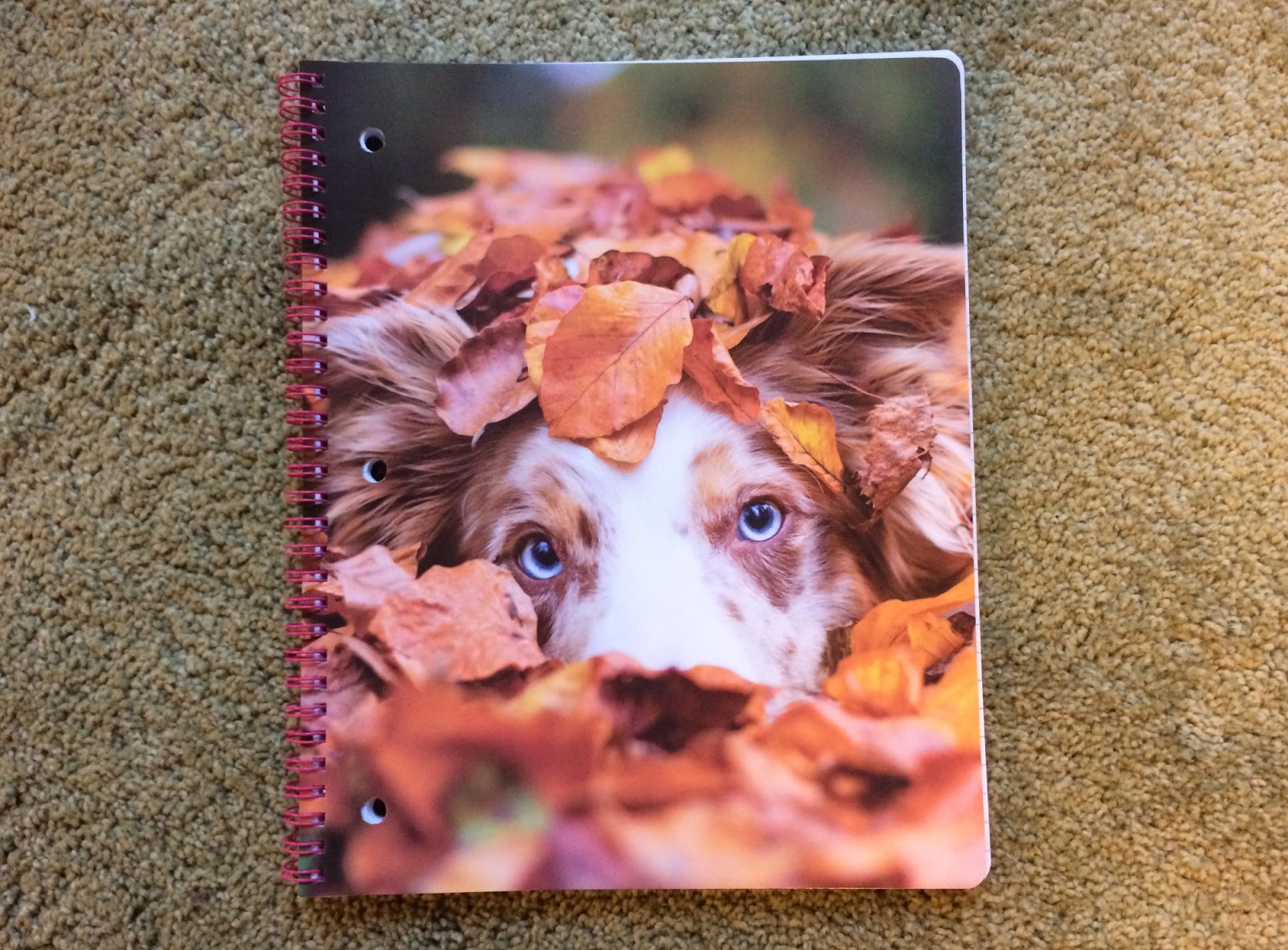
Spiral notebook with photo of blue-eyed dog partially hidden under leaves
NaNoWriMo 2018–“Heavy Rain Likely”
Fortunately, spiral notebooks are abundantly available with all sorts of decorative covers, suitable for distinguishing this year’s project from last year’s. I’m somewhat limited in that I prefer wide-ruled notebooks. I find it more comfortable to write at length if I don’t have to write small. This means that I buy notebooks intended for elementary school kids that have lower-quality paper, as opposed to the nicer notebooks with the smooth, smooth paper that holds up to fountain pen. It also means I end up with a lot of kitten notebooks, and once in a while a Disney princess. I don’t mind “cute”. But fortunately, there are other designs out there too, and every year I’m eager to see what the current crop of school notebooks has in store for me.
Assorted spiral notebooks with covers showing kittens, flowers, or abstract designs
Assortment of other notebooks, not all from NaNoWriMo
This year I’m planning to write a mystery starring the same sleuth I used in last year’s NaNoWriMo. Usually I write middle-grade or young adult fantasy, occasionally science-fiction, but last year I decided to try a mystery. I love to read them, but had never had any success writing one.
I’m not entirely sure I can call last year’s draft a “success” either, but I did finish. (In NaNoWriMo-speak, I “won” NaNoWriMo. That just means I achieved wordcount by the 30th.) I liked the story well enough that I even started revising it, though I ran into problems and have temporarily shelved it. I also really liked my sleuth.
So this year Tabitha Key will face a missing person case, while being threatened by a hurricane. (Yes, I was thinking about this year’s story as we waited to see whether Florence was actually going to come anywhere near us. And then Michael. We were fortunate—waiting was about as far as my experience went.)
I don’t know whether I’m going to “win” NaNoWriMo this year. I’ve been distracted and I don’t feel quite as ready to write this mystery as I have with some previous stories. I’m hoping that as the final week approaches, I will suddenly feel more inspired. I do have some notes, at least.
Naturally, these notes are in my new spiral notebook. I chose this year’s notebook not just because it shows a cute dog, but also because the dog is partially hidden under leaves and the story is about someone who is missing—hidden, in fact. The picture on the notebook didn’t have to go with the story—I could have just picked something because it was appealing, but I like the fact that it does relate to it.
Ten more days to go. I’m starting to feel a little excited about this. Maybe I should throw in a tea leaf reading? A misbehaving donkey? I wonder if a box of chocolates would help—either as part of the plot, or possibly on my desk. I’ve got my StoryCubes® if I need a nudge.
The blue-eyed dog is waiting.
Sidebars, Summaries, Speech Bubbles, Oh My! –text and graphics in recent children's nonfiction

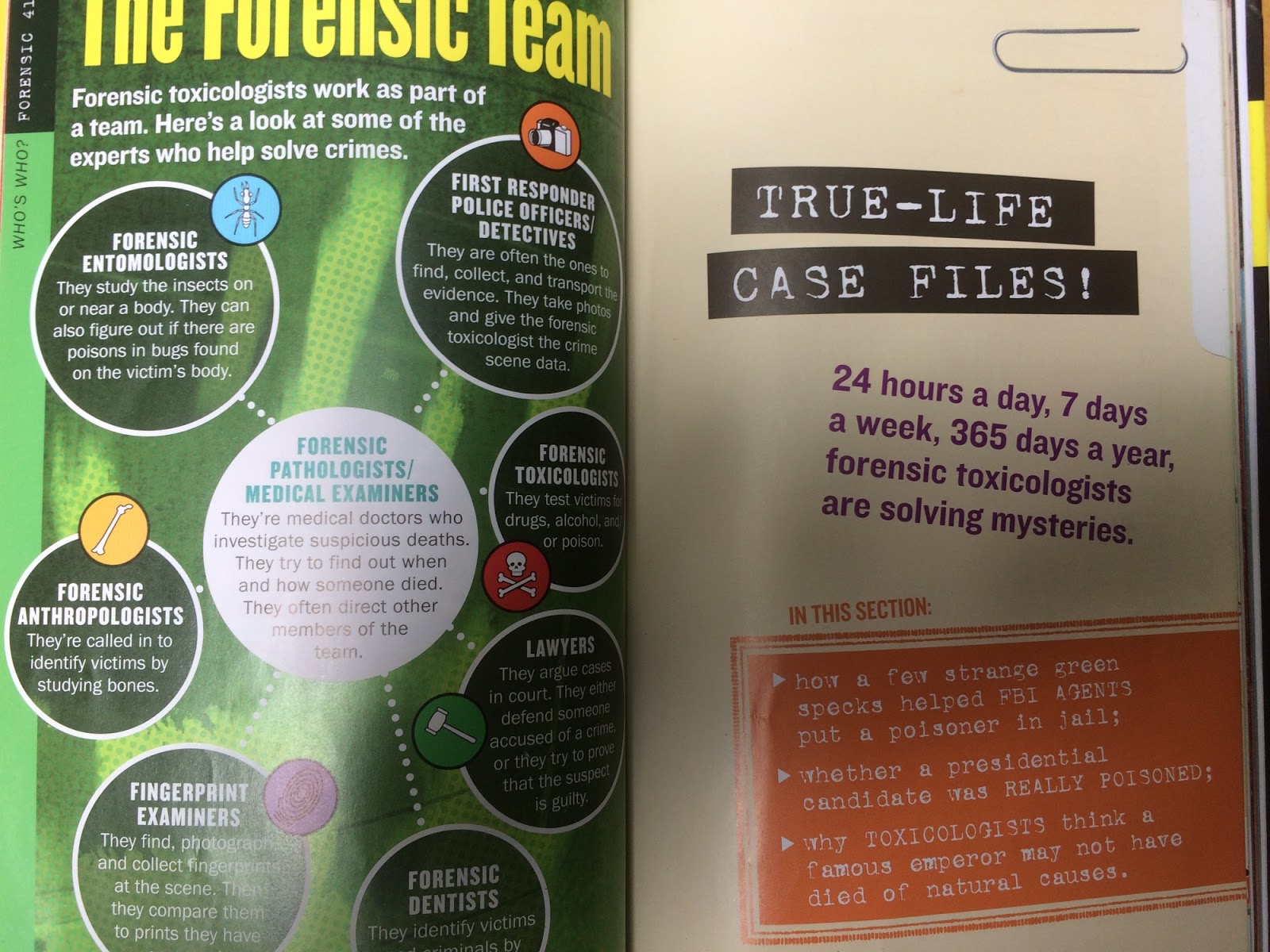
There has been a trend in the design of children’s nonfiction which is not merely heavy on graphics, but which mixes text in with graphics, adds snippets of text elsewhere on the page (sidebars, marginal notes, speech bubbles), and uses a lot of variation in the typeface, color, size, and even the angle of the text (e.g. diagonal). All of this makes the text increasingly difficult to read, especially out loud.
Note the variation in text and even the varied angles.
The first problem is the appearance of the text itself. It is visually distracting, though sometimes attractive. I especially hate it when words in a sentence vary in size, or when they use “bounce” lettering and the letters within words go up and down. (This is probably more common in fiction, actually.) I understand that sometimes there is a sufficiently good reason for this visual effect, especially in poetry, but it always makes it harder to read.
The second problem with all these bits of text is deciding where to start reading. Occasionally there is so much extra text that the main text is hard to find. Let’s assume you’ve found the main text and started reading. The problem with all the sidebars, marginal notes, and speech bubbles is that when you reach the end of the main text on a page spread, you are faced with a decision. Do you turn the page and continue reading the main text, or pause to read aloud the extras? This is especially awkward if the main text ends mid-sentence. But if you skip the extras and come back to them later, you find yourself going back through the book again and reading, in isolation, bits that were meant to go along with earlier parts of the text—an explanation of mummification, say, that was on a page that talked about tombs and the discovery of mummies.
Finally, I’ve noticed repetition of content among the different bits of text. This isn’t a problem with sidebars, which go into detail on some topic touched on in the main text, but often marginal notes and subheadings repeat information that is in the main text. In particular, I’ve noticed some children’s nonfiction (as well as some magazines for adults)  put summaries at the top of sections, just below the heading. Why? If I’m going to read the section, I’ll find out for myself what it’s about. I’d rather not to have the discovery spoiled by being told in advance. If the summary is meant to take the place of reading the text… why write the book at all? And if it’s meant to sum things up after you’ve read the section, why put it at the beginning?
Sidebar and summaries-well, sort of.
I will say that there is one style of book where all this extra text really isn’t a problem. Books divided into topics that each take up a single two-page spread don’t force a choice between turning the page and reading all the extra bits. DK has a lot of very pretty photo books like this. Of course, this also means the book can’t get into much depth on any particular topic or have much of a narrative, but for some purposes that’s just fine.
A pretty photo book.
So why has this design style caught on? Perhaps the increased use of sidebars imitates the use of hyperlinks in on-line articles. But are sidebars/hyperlinks even necessary? Part of a writer’s task is to decide what information to include and in what order to present it. Facts in the world exist in an interrelated mess. The writer has to present his or her selection of facts in a linear way, highlighting some of the relationships among them while leaving out others. It’s the only way to make the result readable. The writer always wants to include more information than can be coherently presented.
Perhaps that’s part of the problem. By putting some of the information in sidebars/hyperlinks, the writer can avoid some tough choices. The problem is that hyperlinks are fairly unobtrusive (underlined blue text, say) while sidebars are not.There doesn’t seem to be any cost to including hyperlinks since they can be easily ignored while reading—and there are no page turns in a blog post or internet article. Sidebars, on the other hand, do compete for attention with the main text. I don’t mean that they aren’t sometimes worthwhile, just that there is a trade-off that must be considered.
What about the other extra bits of text? I suppose they are meant to look energetic and exciting–as though books would be dry blocks of words without the color and dramatic angles they provide. It also suggests to my mind that publishers expect their young readers to have the attention spans of a gnat. I hope they are underestimating their readers. I also wonder if by designing books in this way, they might unwittingly be contributing to the problem.
For myself, I mostly find the busy-ness off-putting. What about you?
Till next post.

Note: The pages in the photos are from Killer Wallpaper: True Cases of Deadly Poisonings by Anna Prokos, and from Mesopotamia, a DK Eyewitness book. They’re both good books.

"The Poisoner's Handbook" and Reading About Real Evil

Recently I read The Poisoner’s Handbook: Murder and the Birth of Forensic Medicine in Jazz Age New York, by Deborah Blum. I was originally looking for information on poisons for a possible new mystery novel, but got caught up in the stories of poisonings, both accidental and deliberate, and the development of techniques for detecting them—not to mention the story of Prohibition in New York, and the politics that was inevitably involved along the way.
It was a very good book, but there was nonetheless something sort of creepy about reading an interesting story about a poisoning and remembering, suddenly, this really happened. Mary Frances Creighton really did kill first her brother, then a friend, with arsenic. A group of three people really did take out insurance on an old drunk, and then kill him with carbon monoxide after several attempts to kill him in other ways failed. Some people—too many—really are capable of doing evil things.
This brought to mind an incident from years ago, in college. Our class had been assigned a reading on pornography by someone whose name I have now forgotten. She described in impassioned terms some incredibly degrading images and corresponding attitudes toward women. Seriously, to say that these people were treating women as objects fails to recognize how much more carefully and gently we treat most of our inanimate possessions. It was extreme.
A number of us were sitting on the steps outside, waiting for class. One young woman started talking about the article, basically saying that it had seemed kind of over-the-top to her. “Who really thinks like that? None of the men I know,” she said.
An older student in the class, a soft-spoken man in his late twenties or thirties, heard her. “I’ve known men like that,” he told her. “They’re out there. Believe me.” I think everyone went quiet for a while after that.
So now I’m thinking maybe I should read about people who do horrible things, if only to remind myself that some people are capable of knowingly and willingly inflicting terrible suffering on others.  I do read about terrible things in the newspaper, but there’s a difference between reading about, say, dictators, who deal in evil on a scale that’s hard to comprehend (and often dealt out through intermediaries), and reading about quite ordinary individuals carrying out quite specific and describable crimes.
I’ve been lucky enough not to have had to deal with anyone really evil. Even people who are merely very unpleasant have generally been on the fringes of my life, not a daily part of it. As a result, perhaps, I tend to look for a charitable explanation for people’s actions.  
Often this is a good thing. But as the cases in The Poisoner’s Handbook show, sometimes there’s no room to wonder whether a person’s intentions were misunderstood or their actions excusable. Killing someone for insurance money makes one’s attitude toward other people quite clear. Sometimes, people really are just that bad.
It’s something to keep in mind.
Till next post.