
A mixture of citrus, cinnamon, and nutmeg–plus butter–is one of my favorite flavor combinations. It started with a hot cross bun recipe long ago, when I used lemon and orange zest in place of some candied citron. Of course, citrus zest is not the same thing as citron, but I thought the candied fruit mix sold in the stores looked weird and unappealing, while citrus zest, either orange or lemon, sounded pretty good. So I used both.
I’ve been pretty happy with my hot cross buns, but I have to admit that they seem to dry out too quickly. So this year I decided to try something new. Earlier this year, I made a recipe for Kanelbullar (Swedish Cinnamon Buns) using a recipe from Cook’s Illustrated (Jan/Feb ’22). They were enormously buttery and sweet, and also very soft. I thought I’d borrow the technique called tangzhong , as well as some extra butter, but keep my favored flavoring and traditional hot cross bun shape.
The tangzhong technique, which seems more or less the same as one called yudane, involves heating some of the flour and liquid together to make a flour paste, then using that in the dough. It’s kind of entertaining and reminds me of making playdough, though the paste wasn’t as stiff and hard to stir. On the other hand, my dough turned out too wet, so maybe I should have cooked the paste till it was like playdough.

Here’s what I baked:
Hot Cross Buns, 2022 version
Soften 4 T butter. Use a microplane grater, if you have one, to zest part of a lemon and part of an orange till you have about 1 tsp mixed citrus zest. (The proportions are up to you.) If you don’t have a microplane grater, just do whatever you usually do for zesting citrus. But if you like to add citrus zest to dishes, I really recommend the microplanes. Add the zest to the butter (you can just put it on top so you don’t forget it.) By the way, this is twice the butter of my usual recipe.
Heat 3/4 cup milk with 1/4 cup (1-1/2 oz) bread flour to make a paste. I found it easiest to warm the milk in the microwave just to lukewarm or so, then mix in the flour briskly, then heat it on the stove and stir with a wooden spoon. I think it’s faster than starting on the stove, but easier then pulling the mixture in and out of the microwave to stir it. (Plus, my microwave keeps beeping even after you open the door… a bad design, I think.)
I moved the paste to the stand mixer and add 1/2 cup cold milk, then whisked till smooth. This should avoid the problem of the mixture being too hot for the yeast, but check to be sure.
Add 2 cups (~11oz) bread flour and 2-1/2 tsp yeast. Mix it in. Use dough hook on low for a minute or two. The dough is supposed to look dry. Mine did not look particularly dry, and in fact I had to add more flour later. But if it does look a bit dry, you’re probably on the right track. Then let it stand 15 minutes.
While you’re waiting, mix together 1/3 cup white sugar, 1 tsp cinnamon, 1/4 tsp nutmeg, and 1/4 tsp salt. My usual recipe only uses 1/4 cup sugar, but I thought it could be a bit sweeter. I like to mix the spices with the sugar because I worry that the cinnamon will clump together otherwise. It probably doesn’t make a difference in this case, though.
Add the sugar mixture to the dough and mix on med-low for 5 minutes.
Now add the softened butter (cut in pieces) and citrus zest. Mix on med-low, scraping as needed, at least 5 minutes. You want the dough to clear the sides of the bowl, but stick a little on the bottom. Mine was way too wet and left sticky dough along the sides, so I had to add more flour, a spoonful at a time, until it was about right.
At this point I could have tried my usual procedure for hot cross buns–let dough rise an hour, cut and shape and rise another 30-45 minutes before baking. Instead, I followed the kanelbullar procedure, even though I didn’t really need to end up with a rectangle since I wasn’t going to use a sugary, buttery filling.
Oil a 13×9 pan (I used a glass casserole) and squash the dough in there, flip it and squash some more into an approximate rectangle. Cover with plastic and refrigerate for 1 hour.
While I didn’t use a sugary filling, I did need to add raisins. Soak 1/4 cup raisins in warm water. Before using, drain and pat dry with paper towel.
Put dough on floured board. Arrange raisins evenly over 2/3, then fold plain dough over onto raisins, and fold over again. I’m not going to try to explain this better, because really the point is just–add the raisins to the dough so they’re nicely distributed.
Usually I cut the dough into 18 pieces. This time I decided to try 24 (divide in 3, then each in half, in half again, in half again.) In hindsight, I think these buns are too small. I recommend dividing it into 18. (thirds, then thirds, then half)
Arrange them on a baking sheet, cover with a damp towel or such, and let rise for 1 hour.
Before they finish rising, preheat the oven to 425.
I don’t usually put egg wash on my hot cross buns, but I did this time and I think I like it. Mix one egg with 1 t water and a pinch of salt. Brush some on top of buns. Cut a cross on the buns. (This didn’t work very well as the dough was soft and wet with egg wash. Maybe I should have done this before the egg wash.)
Bake till golden, 13-17 min. Let cool on sheet on a rack for 5 min, then remove from sheet and cool on rack at least 10 min more.
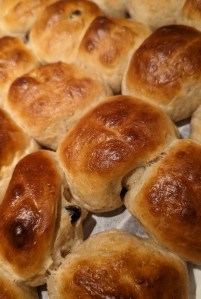
I’m not going to include a recipe for the icing. I usually use an icing made from powdered sugar, a little hot milk, and lemon extract. This time I tried royal icing with lemon extract. I have two things to say. First, if you store these buns in a plastic container, the royal icing will get damp and runny just like the regular powdered sugar icing. I guess it’s all the moisture in there. Second, lemon extract doesn’t last. The flavor changes over time. So if your lemon extract is old, get a new bottle, even if you haven’t made it halfway through the old one. My husband and I compared the new and old extracts and could both detect a difference in how they smelled. I’m pretty sure that translates into a difference in flavor. I did add some fresh lemon zest to the icing to improve it, and maybe using zest alone, or zest plus lemon juice, would be better.

You may notice I’ve been messing around with the format of the recipe, using bold in places and putting a dash so that 1 tsp and a half becomes 1-1/2 tsp. I’m not sure if that’s actually any clearer. If you have an opinion on this, let me know.
Till next post.

 Ravens and Pears