
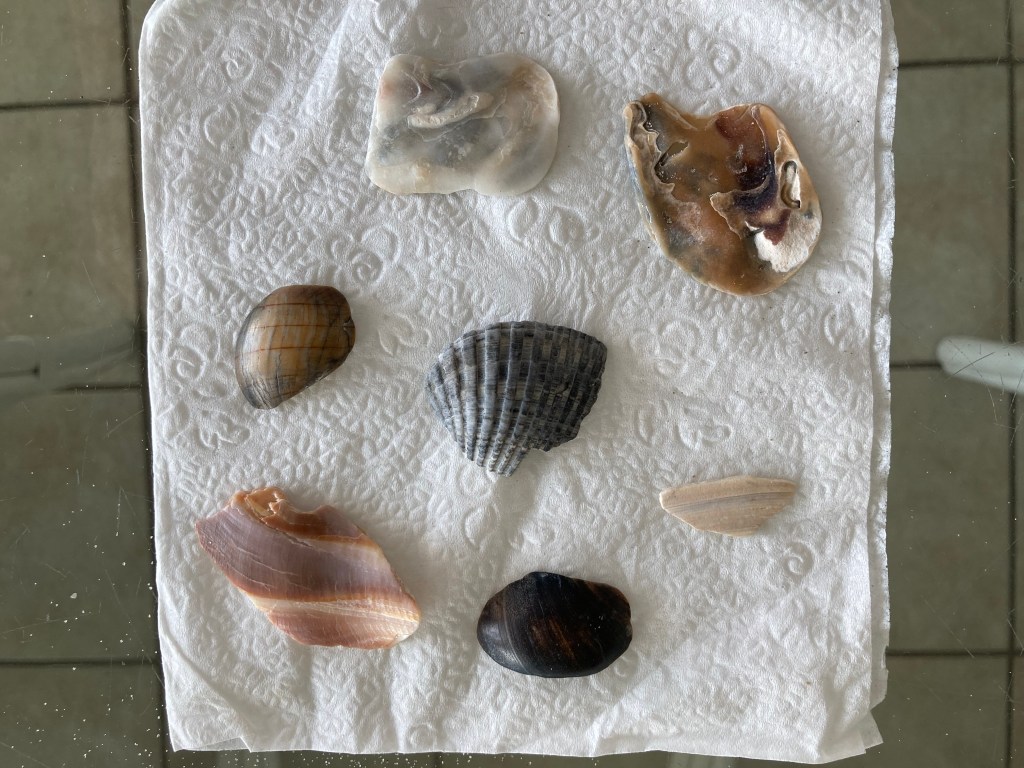
It’s the last full day of beach week. Before I return my interesting assortment of shells and shell fragments to the shore (I really don’t need to bring them home, where they will sit ignored on a shelf), I try to identify them using two guides I have brought along.
The guides aren’t the only nature-related books I’ve brought–I also have a book on plants and one on the beach itself (How to Read a North Carolina Beach by Pilkey, Rice, and Neal). I’ve looked at plants before, though the only one I reliably remember is pennywort, with its peltate leaves like little umbrellas. (I had to look that up–“umbellate” is for flower clusters. Also, to be more specific, “beach pennywort” or Hydrocotyle, since pennywort is the name for a variety of plants.)
Back to the shells.

The pretty gold and silvery bits turn out to be jingle shells (or parts thereof.) I recognize the coquinas from previous years of looking at my beach books. Slipper shells turn out to have a distinctive underside, and ark shells (turkey or otherwise) have a very straight hinge with little toothy marks on it.
But why do the turkey ark shells have those rune-like markings on the flat part? When I picked up the first one, I thought someone had etched those on–how interesting–but clearly they are natural. Some seem to have more than others. Are they a part of the shell, or a sign of something that attacked it?
The book about North Carolina beaches clears up one thing that has puzzled me–the black shells that look like other shells, only black. According to the book, those shells were once buried in the mud of a lagoon. In those low-oxygen conditions, “the iron in the shells turns into iron sulfide, which gives them their black color.” Islands migrate over time, and eventually the shells end up on a beach by the ocean. The take-away–they aren’t a different kind of shell, just colored by conditions.
The stripes and streaks and swirls of color lead me to pick up bits and pieces as well. I don’t try to identify them. I just appreciate the variety of color and texture.
Time to shut down this computer and sit on the deck, enjoying the view of dunes and sea. The waves are sparkling out there.
But first–speaking of sparkling, last night my daughter showed me something amazing. In parts of the beach, stomping through the wet sand caused tiny lights to appear. Some kind of bioluminescent creature in the water. I’d never seen it before, perhaps because I almost never go out on the beach after dark.
Till next post.
EDIT: An article in the Chapel Hill magazine mentions the White Baby’s Ear Moon Shell. I think the white shell I have labeled with a “?” in the photo fits the description. What serendipity, to find the shell listed in an article when I was just flipping through the magazine at random.





 Ravens and Pears