
Apparently there is a trend now, among publishers, of “updating” old children’s books with the goal of making them more readable and relevant for today’s children. I read about this in an article recently, and all I could think was “No! What an incredible loss for today’s kids!”
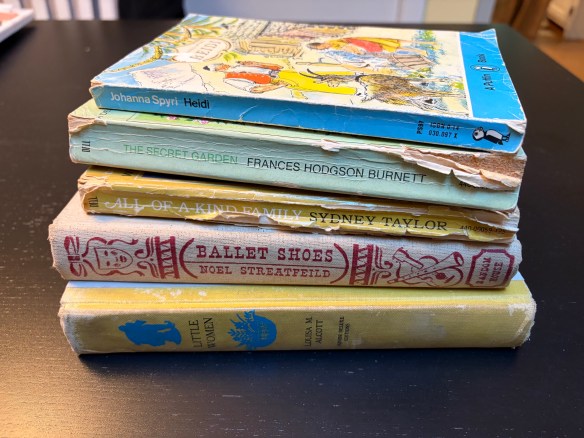
When I was a kid in the 1970s, I read a lot of books. Some were contemporary American books, but not all. Some were old American books, such as Little Women by Louisa May Alcott (1868) or (more recent) All of a Kind Family by Sydney Taylor (1951). Some were British or translated from other languages, such as Black Hearts in Battersea by Joan Aiken (1964), and some were both old and foreign, such as Ballet Shoes by Noel Streatfield (1936, The Secret Garden by Frances Hodgson Burnett (1911), and Heidi by Johanna Spyri (1880). Part of the charm of these books was precisely that they took place in a setting unlike mine. They made reference to things that were unfamiliar to me, but which sometimes (not always) became clear from the context.
To give an example, there is a line from An Old-fashioned Girl by Alcott (1869) which stuck in my head after repeating re-reading of the book. I remember it as
She sucked on her orange with a composure that would have scandalized those good ladies of Cranford.*
Who were “those good ladies of Cranford”? I had no idea, but it was clear that sucking on oranges (a curious way to eat them, I thought) was not considered good table manners. I set the matter aside, along with the discovery that in the story’s setting, eating peanuts out of a bag was also considered déclassé.
Many decades later, I was watching a new mini-series, Cranford. The name of the series didn’t stir any memories, until the ladies who were its main characters were faced with the awkward situation of eating oranges together. The oranges were a treat, but at least one lady wished she could eat her orange in a way that wasn’t approved of by another. A third, younger lady, suggested perhaps they could all enjoy their oranges privately, in their rooms.
These were “those good ladies of Cranford”! The mini-series was based on a book from 1853 which must have been popular in Alcott’s time. What a delight to have this mysterious, intriguing line suddenly illuminated!
So one reason against modernizing children’s books is that it robs the reader of the pleasure of experiencing a different world. There is another reason, a pedagogical one, which is that reading is supposed to “expand one’s horizons.” It’s a way of learning more about the world, and you don’t learn more about the world if your books are carefully designed to contain only things that are familiar to you.
These are also reasons against Americanizing foreign books. As someone who read a lot of British children’s books growing up, I have been horrified that publishers are de-Britishizing books. The most egregious example I’ve run across was a middle-grade story set in London, in which all mention of money was in dollars.
DOLLARS. In LONDON.
Seriously, do you really want children to think that everyone in the world uses dollars? Or that everyone eats the same sort of food, or uses the same words for pullovers?
The reasoning behind modernizing (and Americanizing) is that children will find the unfamiliar references off-putting and it will keep them from reading the book. This is probably is true of some children, which is sad, but certainly not of all.
I wonder if this comes down to the difference between those who enjoy genres like science fiction and fantasy, and those who don’t. In both science fiction and fantasy, reading about an unfamiliar setting is part of the pleasure. Readers expect to run into words they don’t understand (“hraka”, “silflay”), and references that are mysterious to them (“mighty Frith”, “at fu-Inlé”). They either figure them out from context or anticipate that the meaning will become clear later on.
Things are slightly different in the case of old books. The author thought the reference was obvious and so won’t have made a point of clarifying it later. Still, readers can ask someone older or consult Google if they are curious. Or they can simply move on without understanding the reference, as I did with those good ladies of Cranford.
So please, let’s leave the books as they are.**
Till next post.
* The actual line is
‘How does the new book come on?’ asked Polly, sucking her orange in public with a composure which would have scandalized the good ladies of ‘Cranford’.
** I am not discussing the removal of extremely offensive terms from stories where they play no role in the plot and serve only to reflect prejudices of the time. That’s a different issue. I would suggest, though, that if that is done, there should be a short explanatory note at the back of the book, for two reasons. One, because it is educational to know about prejudice existing at the time the book was written, and two, so adults who read an early edition of the book as children don’t start doubting their memory. (Me, re-reading “How the Leopard Got His Spots.”)
Most kids will stop reading at “The End” anyway, but the information will be there for those who look.

