The Hows and Why of My Mini-baguettes–making French bread just because…

Recently I’ve been inspired to make bread.

Usually the only bread I make is sandwich bread. We have a Zojirushi bread machine, and I love it. Bread is easy to make, tasty–the only disadvantage compared to store bread is having to slice it. Like Jacob Two-Two, I seem unable to cut a slice of bread that isn’t “a foot thick on one end and thin as a sheet of paper on the other.”

I think what happened is that I watched one too many episodes of The Great British Baking Show. This led to a couple of failed attempts at ciabatta. I blame this partly on the jar of yeast, partly on our oven’s inaccurate temperature readings and… well, the rest is mine. But making the ciabatta reminded me of the class my husband and I took, years ago, in bread-making.

We had actually signed up because I was interested in using different kinds of flour in my bread-machine sandwich breads, but the class turned out to be focused instead on mixing, raising, shaping, and baking types of French bread  (and also some sourdough.) It was a good class, and when I saw that one of our instructors had written a book with all her bread-making knowledge (she was studying bread in graduate school), I naturally bought the book. Bread Science, by Emily Buehler.

The book.

Here I must admit that I have only read parts of it so far. She goes into extensive detail about how bread works. I was interested to learn that the bubbles of gas in the dough are created by mixing–yeast can only enlarge the bubbles, not create new ones. I picked the book up again this week and re-read the sections about mixing, raising, shaping, etc. Then I tried to make the basic bread recipe, which uses a poolish.

A poolish, as we learned in that long-ago class, is a kind of preferment. As in “pre-ferment”. As in, something you make before you actually mix the dough and start the first rise. You take some of the flour, some of the water, and a pinch of the yeast and let the mixture rise overnight, basically. Then you mix that in with the rest of the flour, water, yeast, and salt. The point is to increase the flavor.
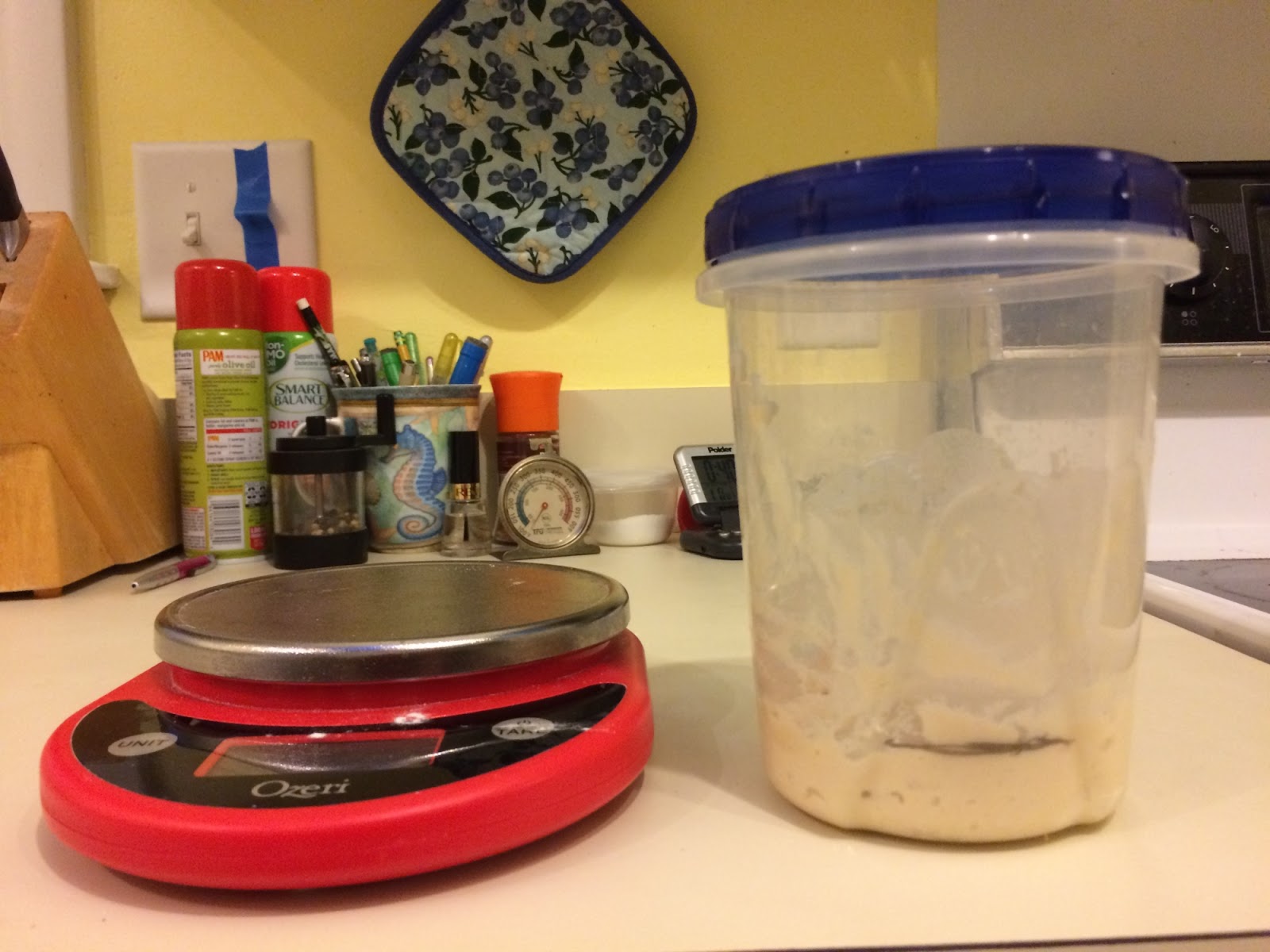
The poolish, before it increased in volume.

See the scale in the photo? I love my scale for all sorts of baking. Also, it can read in either grams or ounces. Very handy if you are trying to follow a British recipe, or a very precise American recipe.

I remember that the dough we mixed in class was on the sticky side, but my first run-through turned out incredibly wet dough. I reread the recipe and saw that she had warned that less water is needed in humid weather. Hmm, summer in the South… but then, air conditioning… but still at least 50% humidity… For the second batch, I reduced the amount of water and got a dough that was sticky but manageable.

The dough, before the first rise (I think).

Then two rises, a “pre-shape”, and finally, time to make baguettes. Or in this case, given that I was making a half-batch and had only a regular size cookie sheet, two mini-baguettes.

The mini-baguettes before proofing.

I did not bake them on my pizza stone, nor did I do anything much toward creating steam in the oven. I was still pretty pleased with the way they tasted and their shape. Maybe next time I’ll work on creating a better crust.
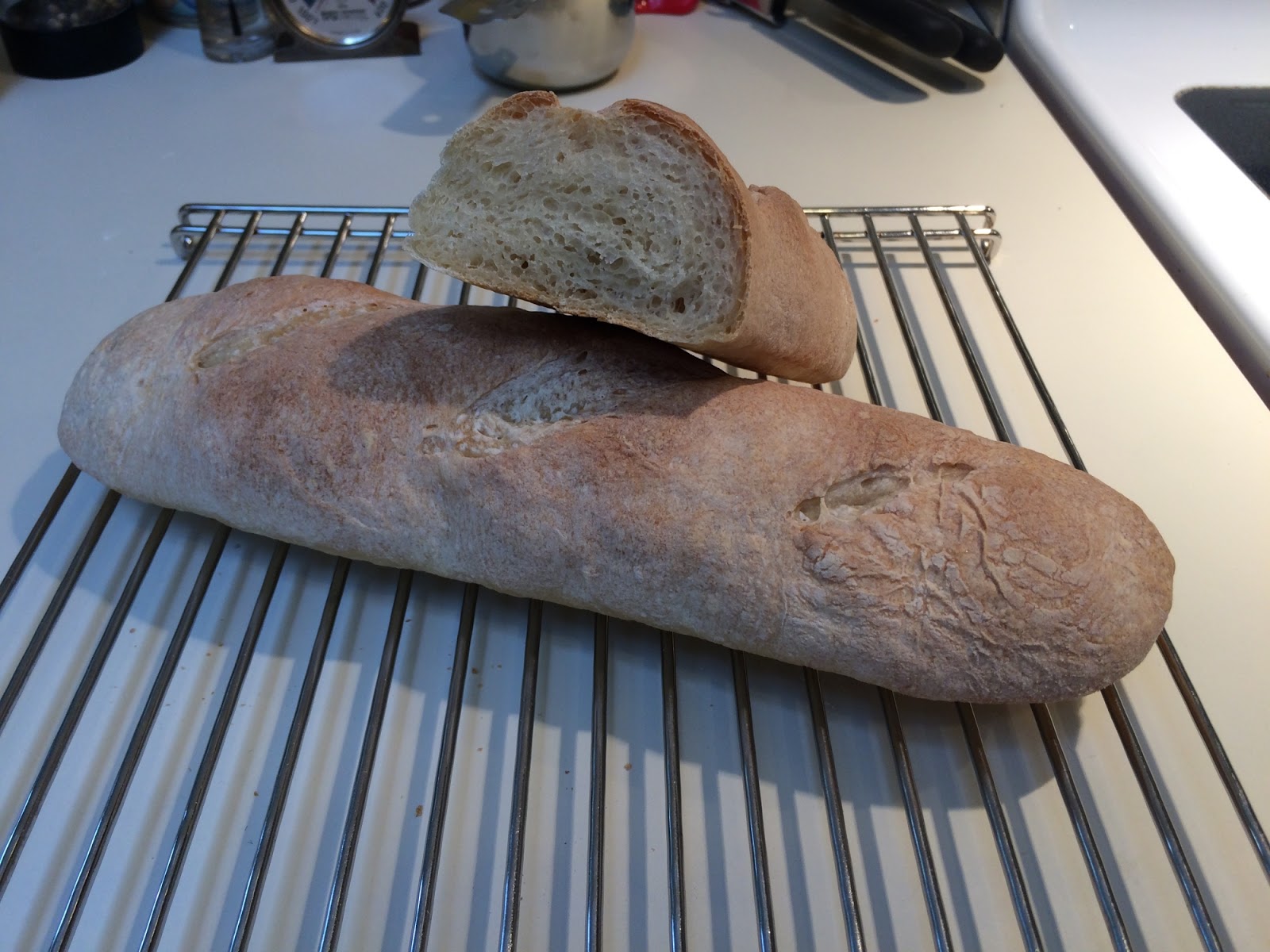
The finished bread.

So that’s the “how” of my recent bread-making. The other question is “Why?” Why go to all this trouble when I am fortunate enough to live very near a co-op that has an excellent bakery? (Note: this is where we took the bread class in the first place.)

As I said earlier, I don’t normally make bread apart from easy sandwich bread in the bread machine. I have good reason to make that–supermarket sandwich bread doesn’t taste nearly as good, and while I can get good sandwich bread at the co-op, I have more options if I make it at home. That’s a bit like sewing my own grocery bag or mini-backpack, where I am customizing it according to my own needs and preferences. But when I make French bread, I’m not trying to create something different and personalized–I’m trying to make it as French-bread-like as I can.

So why make French bread?

The answer has to be–to see if I can. Or, because it’s an interesting challenge. Apparently it falls into that category of things which I do just because it is fun to exercise one’s skills. (Crossword puzzles, for instance, or rudimentary juggling.) I suppose if I then got creative with the shaping (braids, crowns, bread alligators) then it would turn into an expression of creativity as well.

So what is the point of this whole post, besides a chance to show off photos of my lovely mini-baguettes? Just that it is a lot of fun to take on a challenge, to exercise skills (must try the ciabatta again), even when it isn’t also an expression of individual creativity.

So go forth and exercise some skills. And eat French bread.

Till next post.
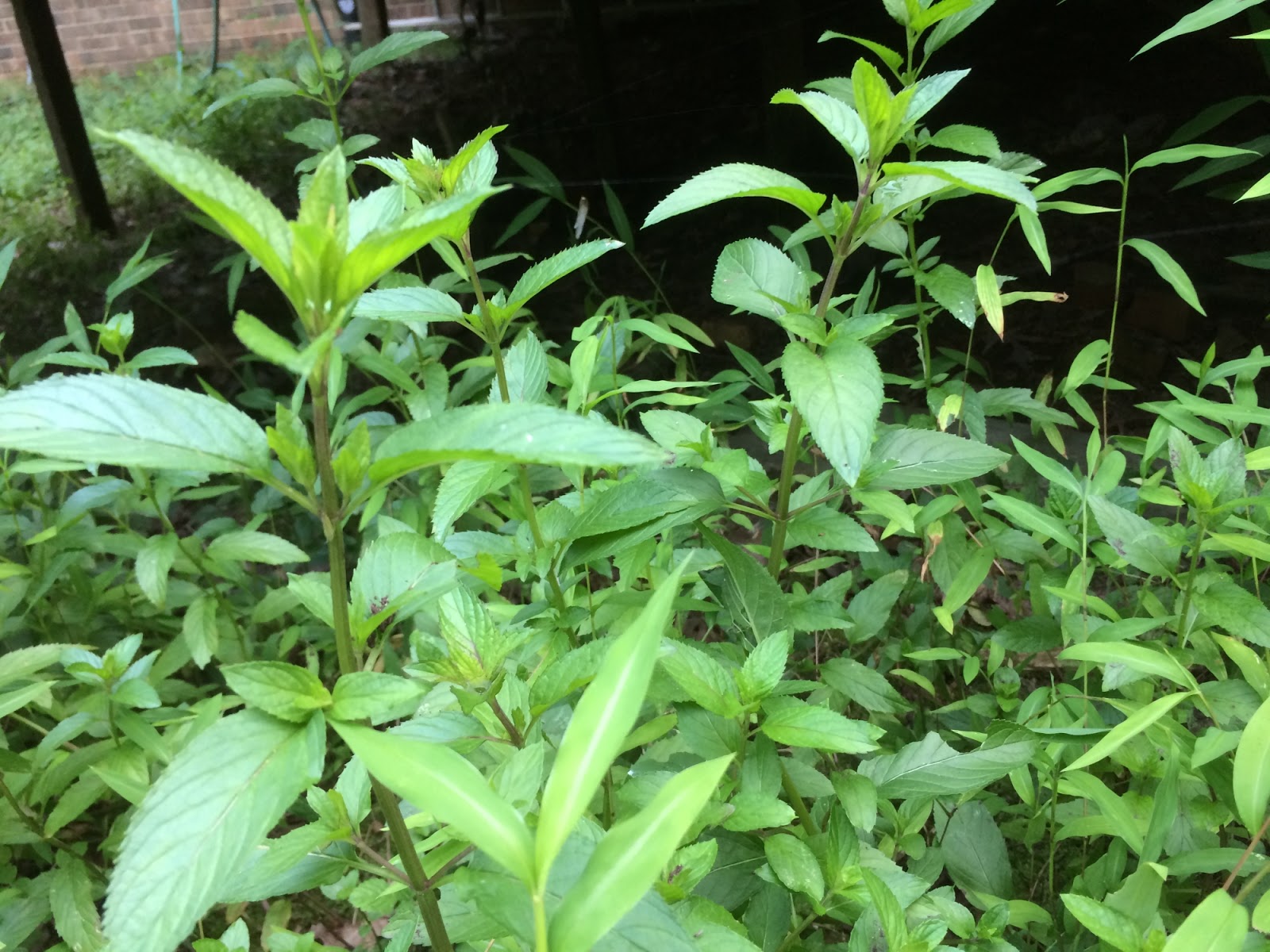
The Many Mysterious Mints

Calling mints “mysterious” is a bit of an alliterative exaggeration. There isn’t much mysterious about mints, unless it’s the fact that such plain green leaves can provide such marvelous scents–scents that vary from pepperminty to perfume-y.

Peppermint plants with weeds in background
Peppermint
 It’s not surprising that I like mints. I like fragrant plants and I like plants that are easy to grow. Mints are both. Mints are also easy to propagate, so one plant can become several via cuttings and the extras can be passed along to friends. Even if you don’t take cuttings, a flourishing mint will spread and become more plants. In fact, the usual warning that comes with mint is “Plant it in a container or it will take over your garden.”

That’s true enough. I planted mint, both spearmint and peppermint, in a shady area by the deck where other plants didn’t want to grow. While the mint beds have had their ups and downs, sometimes flourishing and sometimes not, it is certainly true that whenever they are doing well, I have to keep pulling mint out of the adjacent “lawn”. Those stems move sneakily just beneath the surface, it seems, and suddenly peppermint pops up a foot away from its designated bed.

Spearmint plants with weeds including fern
Spearmint

The front of the house used to be an area of gardening desperation–gravelly soil on top of solid clay, shade, and lots of very hungry deer. I planted ferns and a groundcover (Lamium, which is also in the mint family though not a Mentha) and bergamot mint (a.k.a orange mint, not monarda/beebalm). As neighboring trees were taken down, providing a bit more light to our front yard, the mints flourished. (Apparently deer don’t care for bergamot-flavored leaves.) In fact, they are flourishing so much that the groundcover needs to be chopped back at least a couple of times a season, and the bergamot mint is trying to spread into the “lawn”.

Bergamot mint with stiltgrass in the background
Bergamot (orange) mint
I have four different mints now–peppermint, spearmint, apple mint and bergamot mint. Technically I think I bought two varieties of peppermint (chocolate mint smells like plain peppermint to me) and two varieties of spearmint that may have differed in leaf size (one was “Kentucky Colonel” and the other might just have been generic spearmint), but I can’t distinguish them any more. If I could only have two kinds of mint, I would choose peppermint and spearmint. What delicious smells!

The bergamot mint has more rounded leaves than either the peppermint or spearmint. It smells… like bergamot! Most people recognize the scent as “Earl Grey tea,” which is not surprising since Earl Grey is tea flavored with (actual) bergamot. Also in the front yard I have a small planting of apple mint that has survived despite being nearly choked out by stilt-grass. (Most of my garden is choked with stilt-grass this year.) Apple mint reminds me a lot of spearmint as far as its scent and color, but the leaves are slightly fuzzy. Maybe that’s where the name comes from, since it doesn’t smell like apples. The leaves have the pale green, fuzzy look of young apple foliage.

Flowering apple mint surrounded by stilt grass
Apple mint
There are other mints out there. I don’t grow pennyroyal. I love its name, but I once had a plant and the smell reminded me very pungently of a flea collar. 

I’ve tried to grow Corsican mint, but I can’t seem to keep it alive for long. I keep buying it, because it looks like the most adorable tiny-leafed, mossy groundcover, but with a strong minty smell. I would love to have pathways made of Corsican mint. The problem seems to be keeping it consistently moist and not letting taller plants shade it out. Maybe someday.

I saw on-line that there is a plant called “banana mint.” Does it really smell like bananas? I’m going to have to order one soon and find out.

So what do I use all this minty goodness for?

Surprisingly little. When I was a kid, I would have loved to have had access to all that fresh mint for potpourri and goodness knows what other mad concoctions. I would have filled sachets with the dried leaves. I would have strewn my room with it, and maybe tried packing some in oil as an attempt at enfleurage.

As an adult, I have a few recipes that call for mint (spearmint), and a couple of times my daughter and I tried distilling peppermint oil using a pot, a small glass bowl, an upside-down lid and some ice. We did produce minty water with a slight sheen of oil on it. Mostly, though, I just rub the mint leaves as I pass by and remark on how good it smells.

I do like sweet tea with a hint of mint in it. For some reason, it’s easier to make with dried peppermint. Fresh leaves seem to give a sort of green flavor to tea. It could be a matter of method–maybe fresh leaves need to steep in much cooler water. Spearmint also adds a nice hint of mint.

Methods of making sweet iced tea vary and people can be quite passionate about their own method. Here’s mine, for tea with a hint of mint.


Sweet Tea with a Hint of Mint

Put 4 cups of boiling water in a glass measuring cup with 2 iced tea bags (or 4 regular size) and steep for five minutes. Add a peppermint tea bag for the last minute, or steep longer for more flavor. 
 Mix in sugar (between 1/2 cup and 1 cup, depending on preferred sweetness) while tea is hot. Fill a 2-quart plastic pitcher more than halfway with (fresh) ice cubes. Pour sweetened tea over ice and stir well. Add more ice if necessary to bring to 2 quarts. Serve.

Why I Drink So Much Tea


I drink rather a lot of tea. I start the day with a cup of tea, and then maybe another, probably one around lunch time, and when four o’clock slips around, well… that’s tea time, isn’t it? I’m talking about black tea, by the way, with milk and sugar. I’ve never really gotten to like green tea, and I only occasionally drink herbal “tea” such as peppermint. And while I’ve come to like the sweet iced tea that is simply called “tea” in my now-home state, that’s not the version of tea I’m discussing here.
I haven’t always drunk so much tea. In high school I had some sort of orange-spice herbal tea, and I don’t remember drinking much tea at all in college. Maybe the rise of the coffee shop, with its pastries and convenient tables for studying, had something to do with it. Or maybe it was something else. At any rate, I believe it was an acquired taste. I really like the flavor of a good cup of tea, and yet tea isn’t delicious the way chocolate is, or ripe strawberries. So why do I drink so much of it?
I’m convinced that part of what makes tea so appealing is its associations, both cultural and personal. Consider the contexts in which cups of tea make their appearance in books and pictures. Tea and books. Tea and flowers. Tea and chocolates. Tea served in beautiful china cups off a tray, perhaps in a garden. Tea in the company of friends. Tea accompanying a notebook and pen. Tea-time as a moment of peace and quiet in the day. It’s hardly surprising that I like the idea of tea.
Teapot and cup in Wedgwood pale green china
A lovely cup of tea
There are personal associations, too. When I was small and had a cold, my mom would settle me on the sofa with a blanket and a cup of tea to chase away the sore throat or sniffles. I still believe in drinking lots of hot tea when I have a cold, though in the interests of not overdoing the caffeine, I also drink hot water with lemon, and maybe peppermint with honey. 
Also, as a grown-up going home for the holidays, I really liked tea-time. As four o’clock neared, someone would suggest putting the kettle on, and whoever was home at the time would gather at the table to eat cookies or panettone while talking about whatever came to mind. Tea with company, tea with cookies, tea with pretty cups.
And there are so many really, really lovely teacups out there!
And now, the reality of tea. The reality is that I rarely use my good china, though I do have some nice mugs in frequent use. The reality is that sometimes I make myself a cup of tea and take sips of it while trying to simultaneously empty the dishwasher and feed the cats. The reality is that any tea purchased at an airport and served in a paper cup is almost always lousy (but I drink it anyway.) The reality is that I have a wonderful husband and daughter, but they just don’t care for hot tea, so I’d be better off filling my teapots with iced lemonade if I want a cozy family gathering. 
Mug of tea at a cluttered computer desk
The reality of tea
Why do I drink so much tea? Because I live in hope—hope that the hot liquid will magically create peace, leisure, beauty, flowers, chocolates, and company, even though it is just a cup of water with dead leaves in it. I guess that’s not a bad thing, but maybe this summer I could try serving lemonade on the porch in my good china.