The Great British Baking Show and Grandpere's Recipes–the technical challenge of a dimly remembered cookie

Last year, M and I discovered The Great British Baking Show. I don’t generally watch shows where contestants get eliminated each episode until only a few are left, but the British Baking Show felt different. For one thing, the contestants weren’t voting each other out—they were competing to produce the best baked goods in a given category. For another, they treated each other well, giving their fellow competitors a hand on those occasions when two hands just weren’t enough. And then, of course, they were producing delicious-sounding, highly inventive and often beautiful creations.

In case you haven’t seen it, there are three parts to each show: the Signature Challenge, the Technical Challenge, and the Showstopper Challenge. For the first and last challenges, they plan their own version of whatever has been assigned (“please make Paul and Mary sixteen perfect petits fours, in two flavors”, e.g.). Some contestants come up with very unusual flavor combinations, which makes me wish I could taste their results as well as see them.
The Technical Challenge is different. The contestants are all given the same recipe and ingredients, and left to do the best job they can. Usually the recipe is for something that few of them have ever made before, and sometimes it’s a pastry that none of them have even heard of. On top of that, the recipe is deliberately skimpy on details—the temperature for the oven, but not the baking time, for instance. Recipes for yeast-raised dough tend to leave out rising times, and sometimes parts of the recipe just say, “Make a custard” or “Prepare fruit”, leaving the contestant to fill in the gaps with their own knowledge of baking (and some on-the-spot guesswork.)
A cookbook: 1920s edition Cakes For Bakers by Paul RichardsAnd that’s why I love the Technical Challenge. It’s a test of their overall baking know-how. The more broadly they have experimented in baking and the more they have read about different baked goods, the more likely they are to know something about baking the assigned item. Being practiced  in common techniques helps when the recipe leaves out the details. Even being inquisitive in sampling pastry can pay off— if the contestant has eaten the pastry in question, at least they have some idea how it should turn out.
Now onward to Cakes For Bakers, a cookbook for the professional baker, copyright 1923. This book belonged to my Grandpere, who was, indeed, a professional baker. The book in interesting for a number of reasons. It’s old and refers to things like “pastry butterine” and whether the damper should be closed while baking. The selection of recipes is unlike my household cookbooks—it includes “Monte Carlos”, “Stork’s Nests”, and various kinds of Zwieback and honey cake, for example. It offers suggestions on pricing, decoration, and display of goods, and discusses the use of ammonium carbonate in leavening cookies.
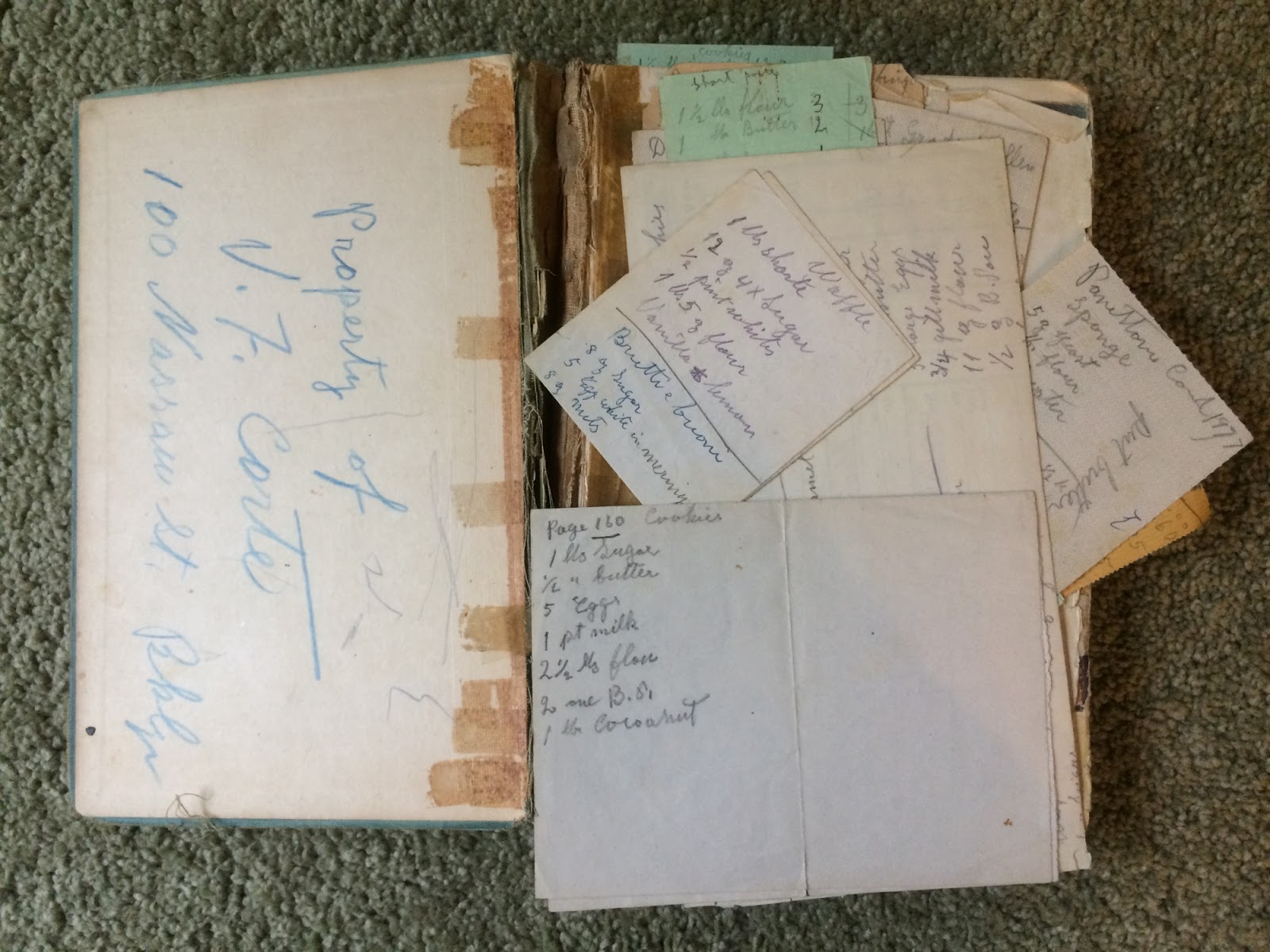
Handwritten recipes on scraps of paper in an old cookbookThe most interesting part of the book, however, is not the book itself but the multitude of scraps of paper that have been tucked into it. Scrawled in pencil on the backs of old checks and garden store forms are recipes—lists of ingredients, really—with no explanation of their existence. In at least one case, my grandfather appears to be copying out a recipe from the book for a butter cookie, but with less lemon. Are these notes on how to vary existing recipes? Recipes from other books? Some appear to be calculations for making a different size batch.
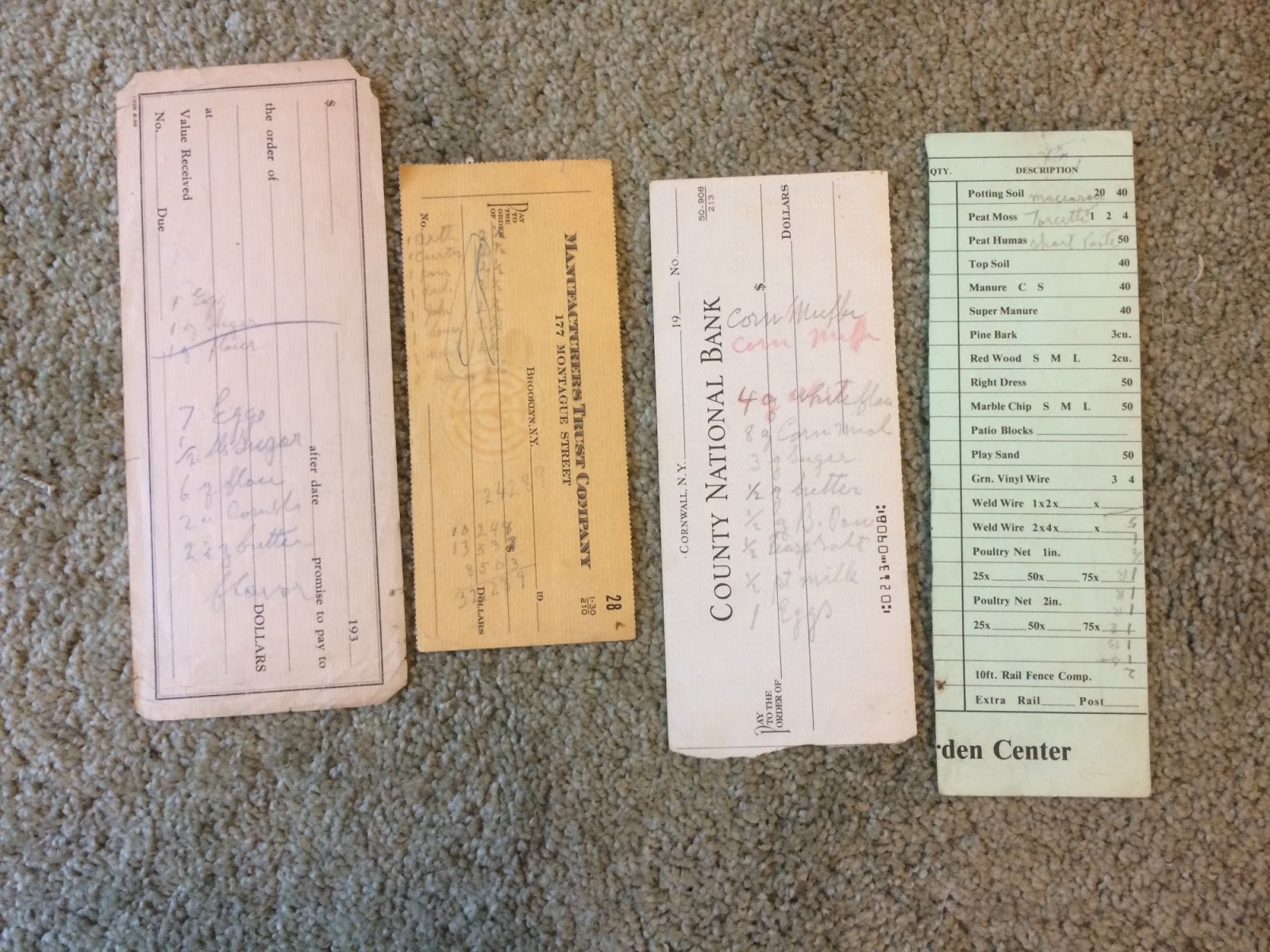
Recipes scrawled on old checks and scratch paper
One thing is certain—there is no explanation of  how the listed ingredients are to be mixed and baked. To use these scrawled recipes, a person would either have to know the technique, or look up a similar recipe and work from its instructions.
For a long time before I had this book, I was trying to find a recipe for a certain kind of cookie that Grandpere made. All through my childhood, when we stayed with them, we ate these cookies which were stored in an old coffee can. There were crescents, ovals with scalloped edges, and leaf-shapes, but they all seemed to be basically the same cookie with different toppings—chopped nuts, tiny chocolate chips, whole cashews, or red candied fruit. My father said much later that they were butter cookies, but the butter cookies I tried never tasted quite right.
Eventually I found a butter cookie recipe with a bit of almond flavor that seemed right—but by then it had been so long that the flavor of the cookie was a dim memory. Still, it seemed possible that the cookies might have had a touch of almond—he put almond in the apple pastry and sliced almonds on the sides of cakes. (I wish I had asked my father whether Grandpere was especially fond of almond flavor. It’s too late now.)
So I was excited when I discovered the cookbook some years ago with its scraps of recipes. Could the answer be here? Maybe the recipe for the butter cookie with lemon? (Though I don’t remember any hint of lemon in the cookies he made.) At least that list of ingredients matched with a recipe in the book, which would help with mixing directions.
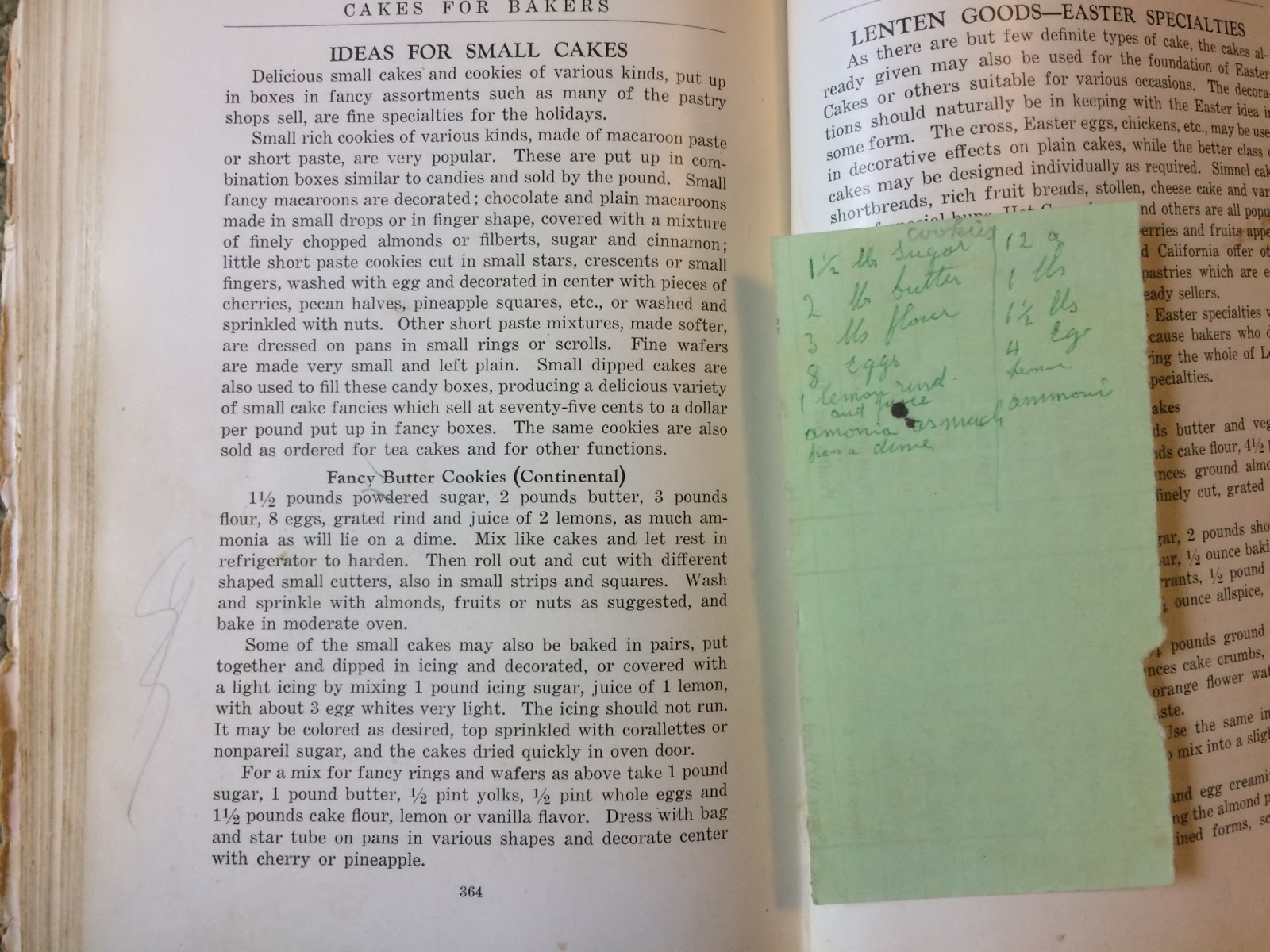
Page from Cakes For Bakers, showing fancy butter cookie recipe, with handwritten versionThe recipe in the book, however, was less than detailed. “Mix like cakes?” How much is “as much ammonia as will lie on a dime?” (I had to look up bakers’ ammonia and an equivalent in baking powder.) Finally, I guessed at the temperature of the “moderate oven” and the time.
The result, as I recall, was not remarkable. The failing could be in the recipe or in my memory of the cookies or both. But the challenge was an interesting one, and I think about it sometimes when I watch the contestants on the Baking Show attempt to figure out their sketchy instructions, and again when Paul and Mary survey the assorted results and compare them to the picture-perfect version they’ve just been sampling in another tent.
If only I had a Chock Full O’Nuts can filled with Grandpere’s cookies for the purpose of comparison, I could figure out that recipe yet.

Till next post.
Simple Joys, Simple Desserts–easy microwave custard


I don’t know what it is that makes complicated desserts so enticing. I can watch episode after episode of the Great British Baking Show (and the Great American Baking Show) and come away with an intense desire to create a Showstopper using multiple exotic flavors and fancy chocolate-work.
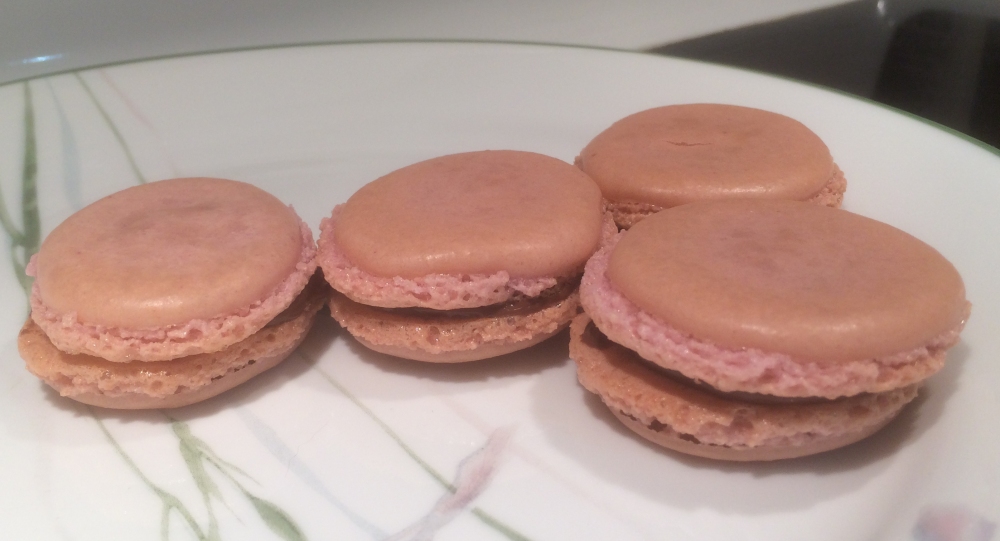
Or, if not a Showstopper, then at least something different and attractive and challenging, like the macarons that my daughter came home enthusiastic about. One of her classmates routinely makes macarons, apparently, and since macarons are made with egg whites, sugar, and almond, there was no problem about finding a gluten-free version.
 I’ve never been very excited about macarons, but they are pretty and it seemed like an interesting sort of project to make with her. We took the easy route on the filling, however, and stuck them together with Nutella.
The macarons were nice, if a bit sweet, but all those egg whites left me with egg yolks in the fridge, and that made me think of custard.
 This brings me to the puzzle behind this article:
Why spend all this effort on a dessert that isn’t really any tastier than a good chocolate pudding?
pink macarons on a plate
If I had to choose only five desserts that I could have for the rest of my life, chances are that one of those would be chocolate pudding (preferably topped with whipped cream.) I’m not sure what the other four would be, but the point is that there are a lot of desserts that are enormously more effort than pudding without being any more rewarding. 
Pudding got even easier when I found a recipe for making cornstarch-based chocolate pudding in the microwave, and then easier again when I discovered that Ghirardelli Sweet Ground Cocoa mix (ground chocolate, sugar, and cocoa) could be used instead of measuring out cocoa powder and sugar.
But here I was, with four leftover egg yolks—just the ingredients needed for custard. I knew from a recipe in Small Batch Baking that small amounts of custard could be made in the microwave. Why not a larger batch?
I found a recipe in Cook’s Illustrated for a rich chocolate pudding that used egg yolks, and made some modifications. (Did it really need all that butter in addition to the cream? What about semi-sweet morsels, since I didn’t have bittersweet?) I tried cooking it in the microwave more or less the way I do for regular pudding, but stirring more frequently. And since I had four egg yolks and only needed two, I made one batch of chocolate and one batch of vanilla.
Very good! I was afraid there might be lumps since I didn’t strain it, but it came out remarkably smooth. (I made this during a water emergency and I didn’t want to have to leave the strainer dirty for who-knew-how-long, or have to wash it in bottled water.)
So here it is—Dangerously Easy Microwave Chocolate Custard, and Dangerously Easy Microwave Vanilla Custard. (I know the original recipe said “pudding”, but when it’s that rich and eggy, I think “custard”.)
Dangerously Easy Microwave Chocolate Custard
3 ½ tablespoons sugar
1 tablespoon dutch-process cocoa powder
1 tablespoon cornstarch
1/8 tsp salt
¼ cup whipping cream
2 egg yolks
1 ¼ cups 2% milk (or use what you have)
2 ounces semi-sweet chocolate chips (about 1/3 cup)
1 tsp vanilla
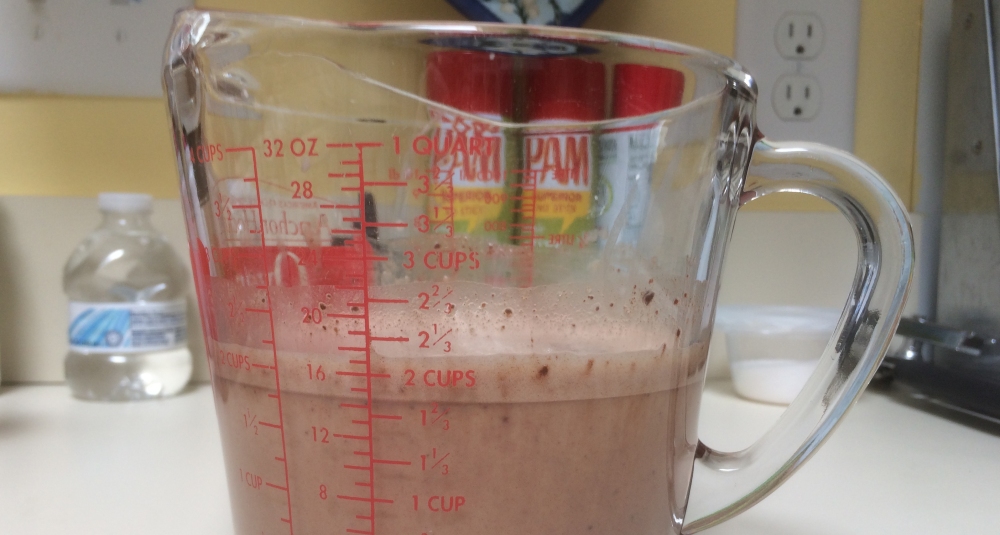
I like to use a 4-cup glass measuring cup to mix in, as it microwaves well and I can see whether the stuff at the bottom is really mixed in.

Mix dry ingredients in the measuring cup. Whisk in the cream. Whisk in the egg yolks, then the milk. (It’s easier to mix if you don’t add all the liquids at once.)

Microwave 1 minute. Stir well with whisk. Microwave in 20 second increments, stirring between each, till custard thickens. Give it 10 more seconds to be sure.
Add the chocolate chips and stir them till they melt in. Add the vanilla. Pour through a strainer if you think it needs it.
Pour into bowl or bowls, and chill. It may need up to 4 hours to chill in a large bowl, but it’s really up to you when you want to eat it. Cover it if you need to protect it from odors in the fridge, but if you cover it while it’s still hot, you may get condensation.
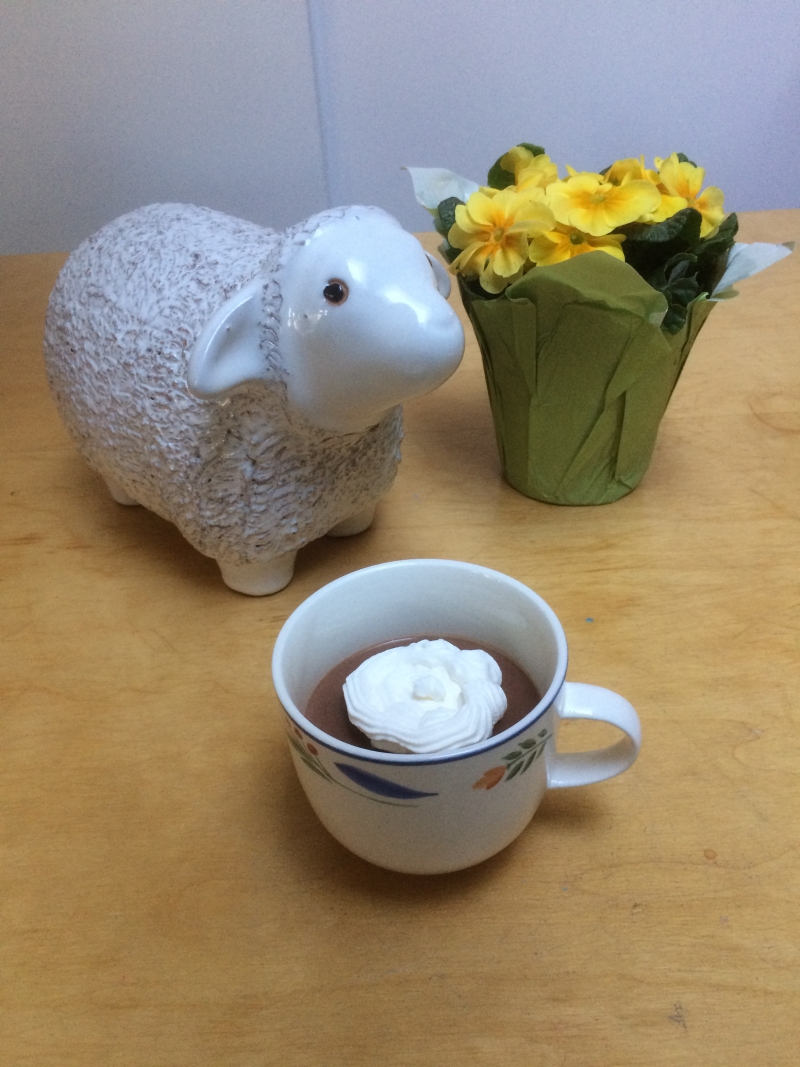
Whip the some of the remaining cream (if you have any) with a bit of sugar and vanilla. Dollop generously on top.
Dangerously Easy Microwave Vanilla Custard
3 tablespoons sugar
1 tablespoon cornstarch
1/8 tsp salt
¼ cup whipping cream
2 egg yolks
1 ¼ cups 2% milk (or use what you have)
1 ½ tsp vanilla
Same procedure, but without having to melt chocolate chips into it.
 
Not-So-Dangerous Microwave Chocolate Pudding
5 tablespoons Ghirardelli Sweet Ground Cocoa
3 tablespoons cornstarch
2 cups milk
2 teaspoons vanilla
In the 4-cup glass measuring cup, mix chocolate powder and cornstarch. Add milk. (It’s easier to mix if you start by adding just a bit, mixing, then adding more.)
Microwave for 2.5 minutes, then stir with a whisk. Microwave for a minute or half-minute at a time till it gets thick and shiny. (There may be a bit of foam on top from whisking in the chocolate powder earlier.) Stir in the vanilla. Pour into bowl or bowls and cool.
If you don’t like a “skin” on your pudding, you can cover the surface with plastic wrap. If you don’t have Ghiradelli’s, use the amount of cocoa and sugar that you would to make two cups of hot cocoa, or melt in some chocolate chips.

chocolate custard in a teacup with whipped cream and next to a ceramic sheep and flowers

Labels in the kitchen—how old is this mustard anyway?


For my first try at a household hint (hello, Heloise!), I’m going to discuss labeling food with the date it was opened. There are two categories of foods that particularly benefit from labeling—leftovers and condiments.

Leftovers are the most obvious candidates for a date-label. You don’t want them to sit around so long that they become unsafe. But how long has that leftover casserole actually been in there?
When I put a plastic container of leftover soup in the fridge, I can’t imagine forgetting that I made soup on Monday. But perhaps Tuesday I go out for dinner, and maybe Wednesday I don’t remember the soup till I’ve already started something else, and Thursday I don’t even think about it. On Friday I pull it out and cudgel my brain. Was it Monday or Tuesday that I made soup? I wasn’t here Tuesday—wait, was it over the weekend? No, surely not. It couldn’t have been last week—or could it?
The situation is even worse in the freezer. I’ve pulled things out only to realize they’d been in there two years (and I know this only because they were labeled.) Not only does it help to put a date on leftovers before freezing them, it also helps to write down what they are. After a few months, vegetarian soup and chicken cacciatore start to look a lot alike. Even pizza sauce and strawberry puree have a vague similarity when frozen.
Condiments usually have a long life compared to leftovers, but in a way, that’s part of the problem. Condiments that don’t get much use—say, plum sauce–can sit in the fridge for quite a long time without getting used up. After a while, it’s hard to remember if that plum sauce has been there for six months, or eighteen. Or thirty-two. Even if it hasn’t gone bad, it isn’t going to be good.
An example: Many years ago, when visiting my parents, we needed dijon mustard for some recipe.
“Oh, I don’t think that mustard can still be good,” my mother said. “It’s been there for ages.”
“It looks okay.”
“Really, I think it’s been years.”
But it was mustard, after all, and it didn’t smell bad. So we used it (and nothing bad happened.) But since my mother had insisted it was old, we bought a new jar of dijon to replace it. We brought it home, opened it, and compared the jars.
It was shocking! The new dijon was brighter in color, with a sharper, more dijon-y smell and taste. The old jar was clearly long past its prime.
In focusing on leftovers and condiments, I don’t mean to suggest that dates can’t be helpful on other food products. When I was single, I didn’t eat much peanut butter, and the longer I’d had the jar, the less I liked the peanut butter and the less I ate of it. Then some reason would come up to buy a new jar, and I’d suddenly discover that peanut butter was actually delicious! I had similar problems with corn meal (a fresh bag made really good corn muffins) and olive oil.
So if you find yourself pulling containers out of the fridge and wondering just how long that lasagna has been in there, and whether the cooked rice is from Monday’s stir-fry or the chicken and dumplings the week before, try labeling your food.
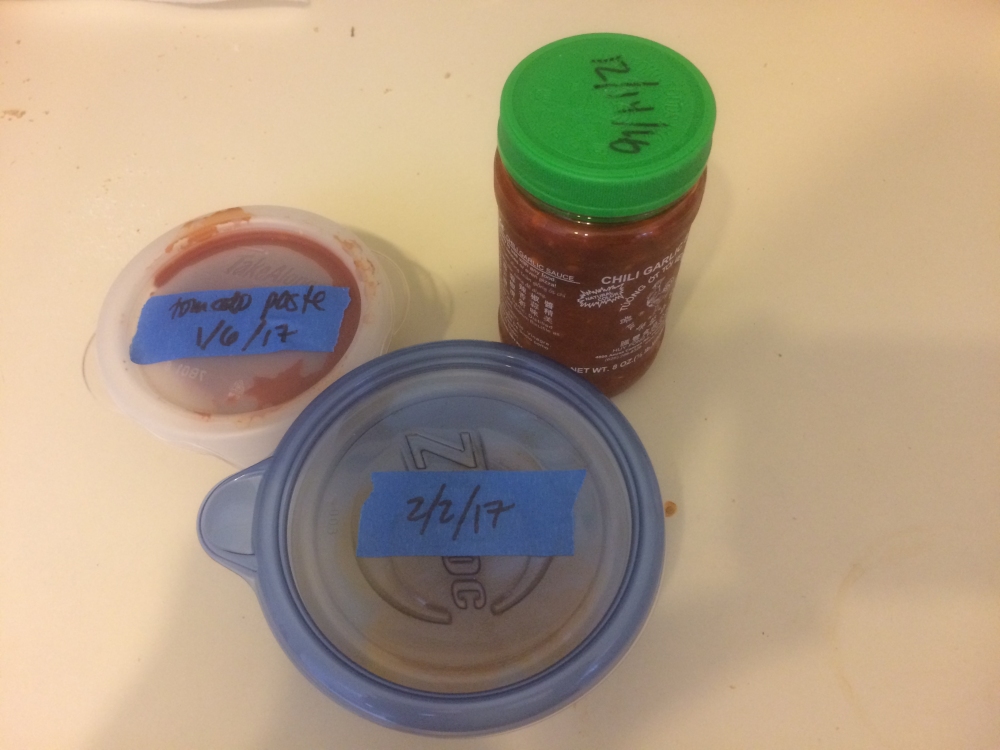
As far as how to label food, I like blue painter’s tape and Sharpie. It’s easy to spot, easy to write on, and comes off plastic containers with no trouble. It also works well on many other food containers, but sometimes it’s just as easy to use Sharpie directly on the label or jar top.
Till next post.