Good Children's Books–good for grown-up or child?


This week I was thinking a lot about picture books and early reader books and what makes some of them better than others. Then I asked myself, better for whom? The grown-up or the child? Is there a difference?
There seems to be. Some of the books my daughter liked and wanted read repeatedly were not books that I liked or would have chosen myself. For instance, some of the books she enjoyed were DK board books—basically, pages of thematically related photos with captions. She had a Halloween book, a book about colors, and I just found the Baby Faces book she adored. These books were incredibly boring to read aloud. There are only so many times that I can point to pictures of spider cupcakes or pink balloons and find something to say about them. “Those would be fun at a party.” But she clearly enjoyed the books.
More interesting to me as a grown-up (though still somewhat difficult to read aloud) was Children Just Like Me. I liked looking at the children from different countries, reading the central text about them, and then examining photos of their favorite meals, toys, drawings, and so forth. Reading this book aloud still involved a lot of pointing at photos, reading the caption, and commenting, but at least it was something more interesting (to me) than spider cupcakes or pink balloons.
On the other hand, there were books that I really enjoyed but which which probably had less appeal for my daughter. In particular, there was a book called Five Minutes’ Peace by Jill Murphy, which was about a mother (elephant) who just wants five minutes to herself away from her rambunctious and demanding children. It was funny and it rang so true for me as an adult, but I always wondered what my daughter was getting from it. After all, she was a child and the mother in the story, patient though she was, really wanted time away from her kids. Did she think it was funny because parents do say things like that? Or funny because of the way the kids hopped in the bathtub with her and made waves and splashed and were naughty children? (Naughty children are the most entertaining kind.)
I also really enjoyed the Commander Toad books by Jane Yolen, but these are most entertaining if you are old enough to appreciate the puns and have enough familiarity with Star Trek and Star Wars to catch the references. Since they are early reader-type books, it seems likely that the grown-up doing the reading is going to get more of the humor than the child being read to. Still, the books have enough adventure and uncomplicated humor to be fun for the child as well, and it’s good to be dipped into wordplay early on.
Probably most of the really good books appeal equally to children and adults. I really liked Bread and Jam for Frances as a child—Frances’ rhymes are fun, and I could understand the situation of someone really, really liking a food more than anything else until suddenly they don’t. I can’t say the book inspired me to “practice with a string bean”, but I did love to hear the detailed description of  Albert’s lunch and later, Frances’s lunch. I still like this book, and for the same reasons.
I don’t remember how I felt about Frog and Toad as a child, but I love them now. The situations are mostly universal ones: not wanting to get out of bed, being reluctant to try something new, wanting more cookies than is good for one, running into unexpected problems with a task, and getting all upset about something that turns out to be silly. The characters are clearly defined. Toad is the one who worries, who is reluctant, who is sometimes quite silly, but who, it must be said, retreats with dignity when his pride is offended. Frog is easy-going and a loyal friend. He never gets mad at Toad, even when Toad is being especially silly or stubborn.
The conflicts in the stories are clear, too. Frog wants Toad to share spring with him, but Toad wants to sleep. Frog and Toad both decide to make a nice surprise for the other, but the weather foils them. Frog sends Toad a letter to make him happy, but the snail takes too long to get it there. Toad prepares to rescue Frog from imagined dangers, only to find Frog safe and sound.
And then there’s The Cat In the Hat. It has beautifully smooth rhyming, a frantic fish who is worried about the children’s mother coming home, and a mischievous cat who likes to play games—games that are dangerous in the “you’re going to break something!” kind of way, not the “someone’s going to get hurt!” kind of way.
My daughter enjoyed The Cat In the Hat, but did she like it as much as I do now? I don’t know. I do remember that she enjoyed it. Maybe part of the reason I like these books so much now is that I have gotten pickier about books over the years, so the ones that still read well (to my grown-up self) stand out as especially good.
Fortunately, we had plenty of opportunities to read aloud when she was young, so we were able to try a lot of different books, some better for her, some better for me. (Thank you, public library!!) And it’s possible that the occasional reading of Five Minutes’ Peace gave me the patience for yet another reading of the Halloween book.

Candy Hearts and Conversation Sweets


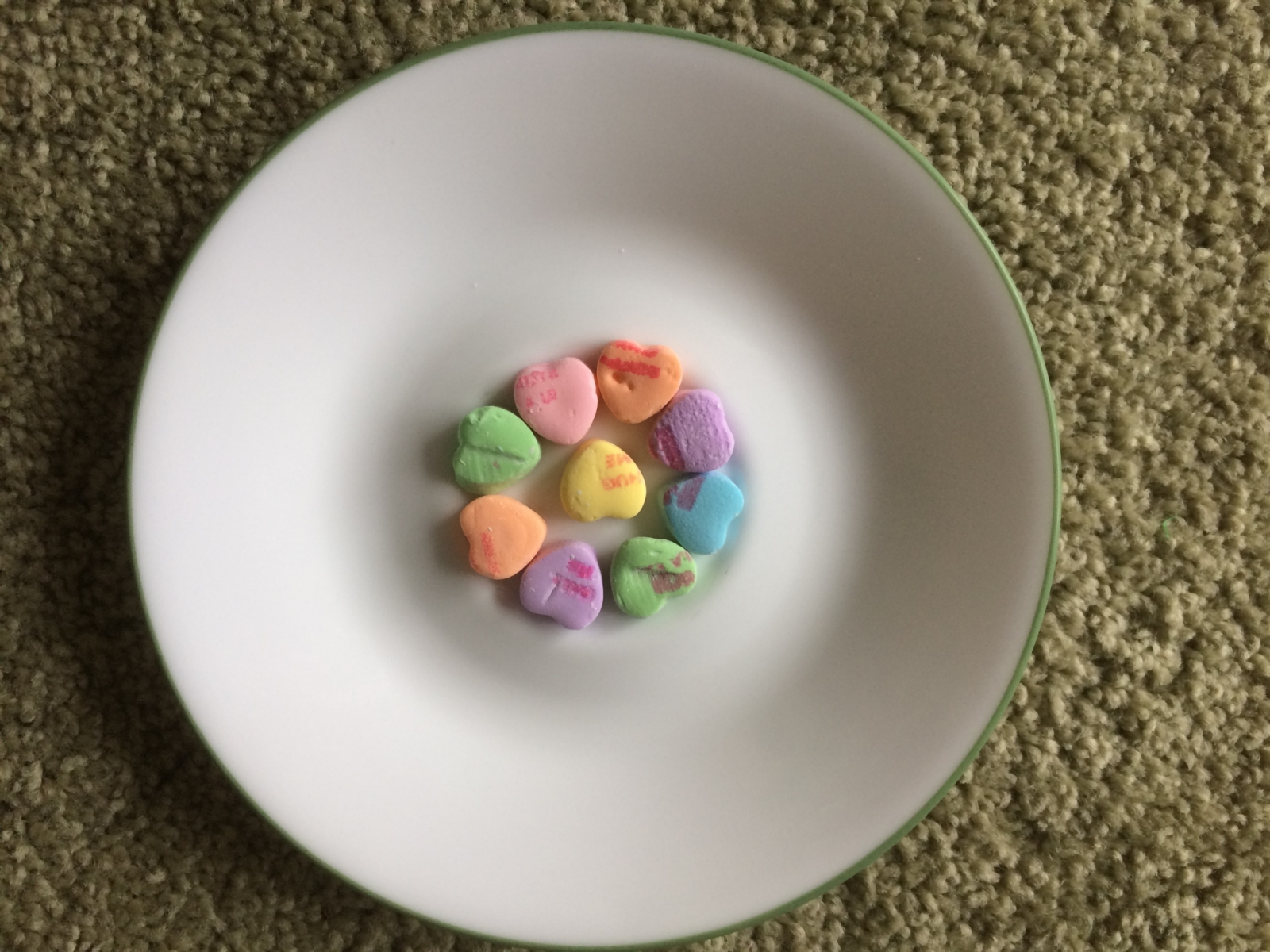
Valentine’s Day is nearly here. Shelves in stores are crowded with red and pink containers. Much of the space is taken up by chocolate in heart-shaped boxes, but there are also a lot of bags of what is basically heart-shaped sugar. The most Valentine’s-y of these are the candy hearts.
Candy hearts are so appealing that you can find them depicted on fabrics, wrapping paper, and cards. I guess Hershey’s kisses show up once in a while, but candy hearts are a much more popular Valentine’s Day icon.
What’s so appealing about them? I think it’s the messages. Without messages, candy hearts would be just another heart-shaped candy that isn’t chocolate. Boring.
But what is it about the messages that makes candy hearts fun? After all, they aren’t exactly poetry. Mostly candy hearts offer a random assortment of sentimental cliches and catch-phrases, nothing particularly interesting or original.
I think what makes them fun is the very fact that you get such an assortment. You can pick through the hearts till you find just the right message to hand to a particular person. It might be a compliment: “Shining Star”, “You Are Nice”, or “Dear One”. It might be a request: “Be My Friend”, “Let’s Talk”, “Dance With Me.” It might even be a question: “Will You Marry Me?”
Alternatively, you can draw one at random and be surprised. It’s a bit like a fortune cookie.
It occurs to me that, like many other things, candy hearts lend themselves to stories. What if someone pulled a candy heart out of a jar, just for a quick mouthful of sugar, and discovered that it said something really unexpected?
 “You are being watched.”
 Or: “She’s lying.”
Or: “Look up.”
In fact, candy hearts (or something like them) do show up in stories. In Mary Poppins Comes Back by P. L. Travers, Mary takes the children to a very odd store where she asks for “an ounce of Conversations.”
“‘Are those the Conversations?’ asked Jane, pointing to the Jar. ‘They look more like sweets.’

‘So they are, Miss! They’re Conversation Sweets,’ said Uncle Dodger, dusting the jar with his apron.”
Jane gets “a flat star-shaped sweet rather like a peppermint” with the words “You’re My Fancy.” Michael pulls out a shell-shaped one with “I Love You. Do You Love Me?” The twins, John and Barbara, are given “Deedle deedle dumpling” and “Shining-bright and airy”, but Mary Poppins’s sweet is shaped like a half-moon and reads, “Ten o’clock to-night.”
Naturally, Mary Poppins explains nothing, and equally naturally, strange things happen that night at ten o’clock.
The tales of Raggedy Ann also involve a candy heart, if I remember correctly. A disaster leads to Raggedy Ann being restuffed, and the woman repairing her puts in a candy heart that says “I love you.” Later, Raggedy Ann falls in some water, and she tells her friends that since the candy has melted, the “I love you” is now spread throughout her insides.*
But enough about stories. Setting aside the content of the messages for the moment, how well do candy hearts succeed at being Valentine decorations? The colors are fine and so is the shape, but I have mixed feelings about the way they are printed. I like the large ones from Brach’s because they have longer messages, but the words look like they came from a bad dot-matrix printer. On the positive side, I suspect whatever technique they are now using allows them to vary the messages more, which is all to the good. Maybe the quality of the print will improve over the coming years. The Sweetheart brand small hearts have a long way to go—they are often barely readable.
And how well do candy hearts succeed at being candy—that is, how do they taste? I bought the small Sweethearts because Sweethearts are made by the New England Confectionery Company, which makes NECCO wafers. I like NECCO wafers, and the hearts looked as though they were made of the same stuff, so I expected them to taste the same.
When I tasted the various colors, though, I wondered if they’d changed the flavors of their hearts. I don’t remember green being green-apple flavored, and the blue… did they even have blue hearts earlier? A quick check on-line shows that the flavors changed some years ago, which makes me wonder when I last bought Sweethearts. (They contain gelatin, so maybe not since my daughter went vegetarian?)
Since I don’t like the flavors very much, and certainly don’t need the extra sugar, I wonder if it wouldn’t be better to skip the candy altogether and substitute colorful paper hearts or wooden hearts with messages on the reverse. (I’m sure these must exist.) But then what does your friend or sweetie do when you hand them a suitably-messaged heart? Keep it forever? Smile appreciation and then toss it in the trash? (Or back in the bowl, if it’s a wooden heart?) There’s something to be said for being able to pop the message in one’s mouth after reading it.
Happy Valentine’s Day!
Till next post.
* Build-a-Bear uses a non-edible version of this trick.

The Idea of Soup


It’s cold outside and there’s a thin layer of snow on the ground. January. My mind is filled with The Idea of Soup.
Really, I should say it is filled with My Idea of Soup. Yours may be quite different. My Idea of Soup tends to be filled with chunks of vegetables, possibly also with beef but not chicken, and garnished with chopped parsley. I don’t think I ever actually garnish soup with chopped parsley—I rarely remember to add parsley at all. But in My Idea of Soup, there is fresh green parsley.
My Idea of Soup. Where did it come from? I can think of several sources.
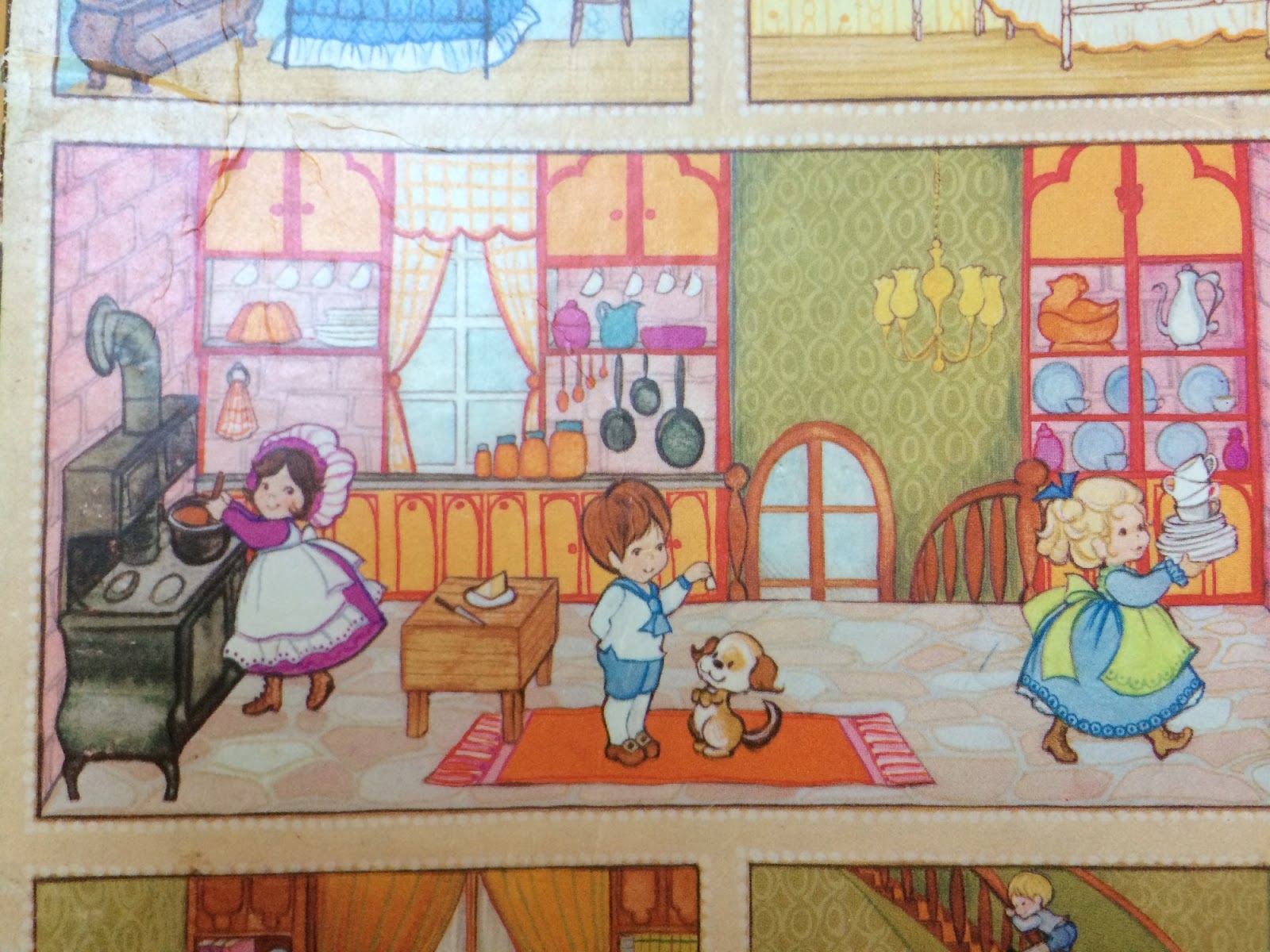
One is my favorite jigsaw puzzle, “Cubbyhole Cottage.” I was six or seven years old when I received it—my younger brother got a 60 piece puzzle with a jet plane on it. We used to have competitions to see who could put their puzzle together faster.
Cubbyhole Cottage jigsaw puzzle by Springbok
Cubbyhole Cottage, by Springbok
I liked to imagine myself as one of the people living in this old-fashioned house. Most often, I imagined myself as the girl in the purple dress and cap—the one stirring the soup. She seemed like the most important person in the house, as she was making the meal. The others were tidying, or setting the table, or watering the flowers, or just playing. Not nearly as important. Also, I liked the girl’s ruffle-edged apron.
Close-up of kitchen in Cubbyhole Cottage jigsaw puzzle
The hearth is the center of the home, even if not quite the center of the puzzle.
Another source for My Idea of Soup is a story by Margaret Wise Brown, “Mister Dog”, in a book of bedtime stories from long ago. The illustrations are by Garth Williams, one of my favorite illustrators.
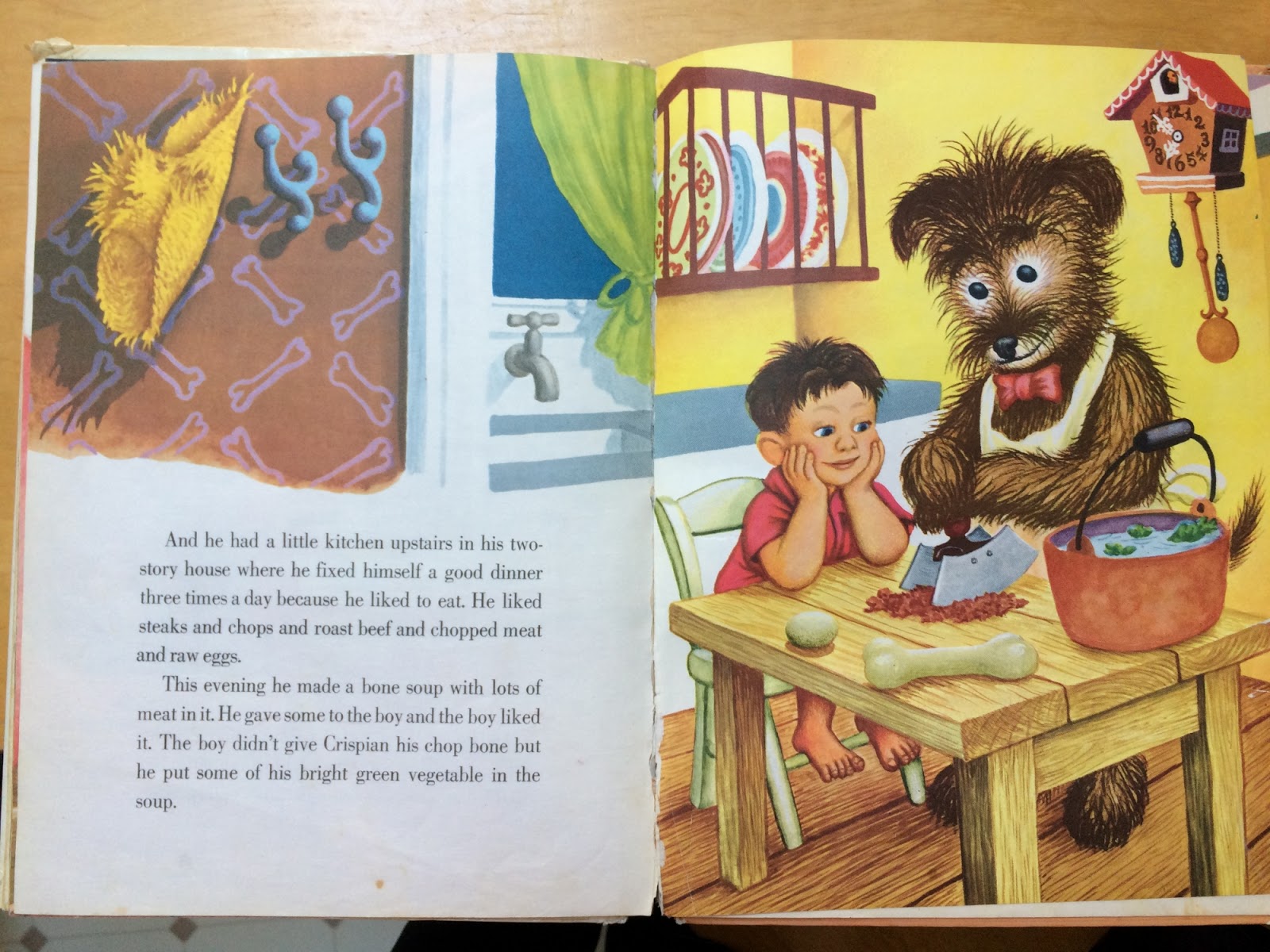
The story is about Crispin’s Crispian, a dog who belongs to himself. One day, after various adventures,  he meets a boy who belongs to himself and invites the boy to come live with him. They stop by the butcher shop on the way home, and the dog buys a bone while the boy gets a lamb chop and “a bright green vegetable.” The dog makes soup and gives some to the boy, who contributes some of his bright green vegetable to the soup.
Page from Mister Dog, showing boy and dog with soup and green vegetable
See the bright green vegetable in the soup? Also, I love the cuckoo clock.
And now you know why My Idea of Soup is garnished with fresh parsley.
Finally, there is the old story of Stone Soup. There’s something appealing about all those people contributing a bit of this or that to the pot, and ending up with a tasty, nourishing soup “from a stone!” I love that idea.
Alas, in practice I’ve found that adding random vegetables to my soup tends to work about as well as mixing a lot of random paints together. The result is muddy and not particularly appealing. Even when I try to stick close to basics, the results are variable. However, the following ingredients generally work for a “Parsley, Sage, Rosemary and Thyme” soup (except that as I said earlier, I tend to forget the parsley.)
·         Some chopped onion, usually sauteed in a bit of oil first
·         Bite-size stew meat, dusted in flour and browned a bit before adding liquid (now cooked on the side so the rest of the soup can be vegetarian—but add some broth to the meat to take advantage of the browned bits on the pan)
·         Canned diced tomatoes with liquid
·         Carrots, diced or bite-size as you wish
·         Water as needed
·         Potatoes, in bite-size pieces
·         Salt and pepper
·         Sage, rosemary, and thyme
·         Parsley, either dried with the rest of the seasoning, or fresh and added at the end
Sometimes I add a bay leaf or a splash of soy sauce. Sometimes, if it doesn’t need to be vegetarian, I add a dash of Worcestershire sauce. I’ve tried adding mushrooms, but results vary. Sometimes I add some broth along with the water, but I don’t like the way a lot of vegetable broths taste and I’m not sure whether they help the soup or not. Basically, I keep messing with it, but I haven’t been keeping accurate records so I don’t have a good sense of what’s working.
So I guess that’s what I should do, to fulfill My Idea of Soup. I should keep records the next time I make some vegetable (and beef) soup. Maybe I’ll even make some tonight. After all, it’s freezing outside and my husband has a cold.
Coziness and caring. Isn’t that what soup is all about?