Writing a Mystery Without Murder In My Heart


It’s November! Finally it is National Novel Writing Month—NaNoWriMo. This year, I am trying to write a mystery–adult, not middle grade or young adult. I need 50,000 words by the end of this month, and a beginning, middle, and end.
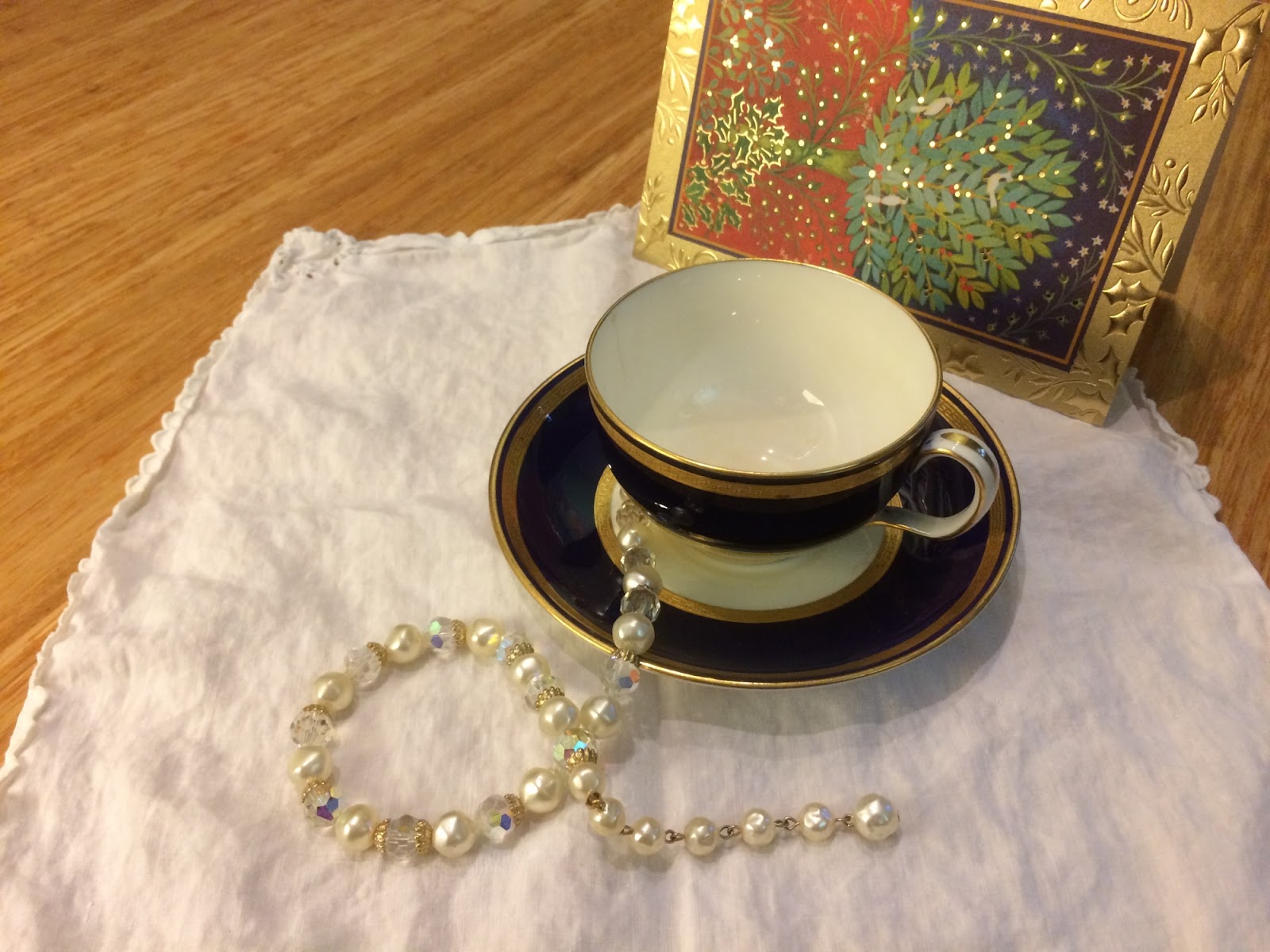
Tea cup on scalloped white napkin with necklace and Christmas card.
Tea, jewels, and Christmas–all part of the story.
I’ve tried to write mysteries before without success. Somehow my mind doesn’t work in the right way for plotting a clever murder (and how the murderer will nonetheless fail to get away with it.) I have the same problem with heists and other criminal plots. I love to read books with ingeniously carried out crimes, but I draw a blank when I try to think one up myself. I think other authors must look around them, wherever they are, and notice potential murder methods. As in “Hey, look at the spike on that beach umbrella. I wonder if you could kill someone with it, then put the umbrella up so no one would notice the blood on the spiky bit.” And other such thoughts.
Okay, so apparently I can come up with a murder method, at least a weak one. But it doesn’t happen easily or spontaneously.
There’s another, more serious, problem. I don’t really want to write about a murder.
I have no difficulty enjoying mysteries in which one (or two or three) people are murdered. You’d think it might bother me, but it doesn’t. Granted, I avoid the really dark, disturbing varieties of murder mystery, but I don’t read only the humorous or cozy variety, either. One of my favorite series is the one with Inspector Gamache, by Louise Penny, which is serious but not overly dark.
So why doesn’t murder bother me when I read a mystery? I suppose it’s sufficiently unreal, and so entirely expected, that I don’t take it to heart. And yet, when I set out to write a story in which one of my characters kills another one, it feelsdifferent. To make sense of the murder, I have to have a character who is so dark or so desperate that he is willing to kill. And I have to have other characters who can be suspected of being that dark or desperate. Suddenly it all feels much too serious—a world I don’t want to live in long enough to write about.
It could be partly that I have been very lucky in my family, neighbors, and co-workers throughout my life. I haven’t had a lot of experience with the kind of people that make you really want to kill them, or the kind of people that leave you scared for your own safety. Mostly I meet those people in fiction—and then I do see red and want violent things to happen to them. Maybe if I had to live with such people, I would be more interested in putting those people in a story and either killing them off in a painful manner, or meting out justice to them after having them kill someone. Or maybe it’s got nothing to do with that. I really don’t know.
So I’m not writing a murder mystery. At least, I don’t think so. The plan is for a robbery to take place, but lots of things could change over the course of the month. Somehow I’ve already gotten 10,000 words in (which is a speed record for me, I think) but I haven’t gotten much farther than introducing my cast of characters. That theft better happen soon or I won’t have a story.
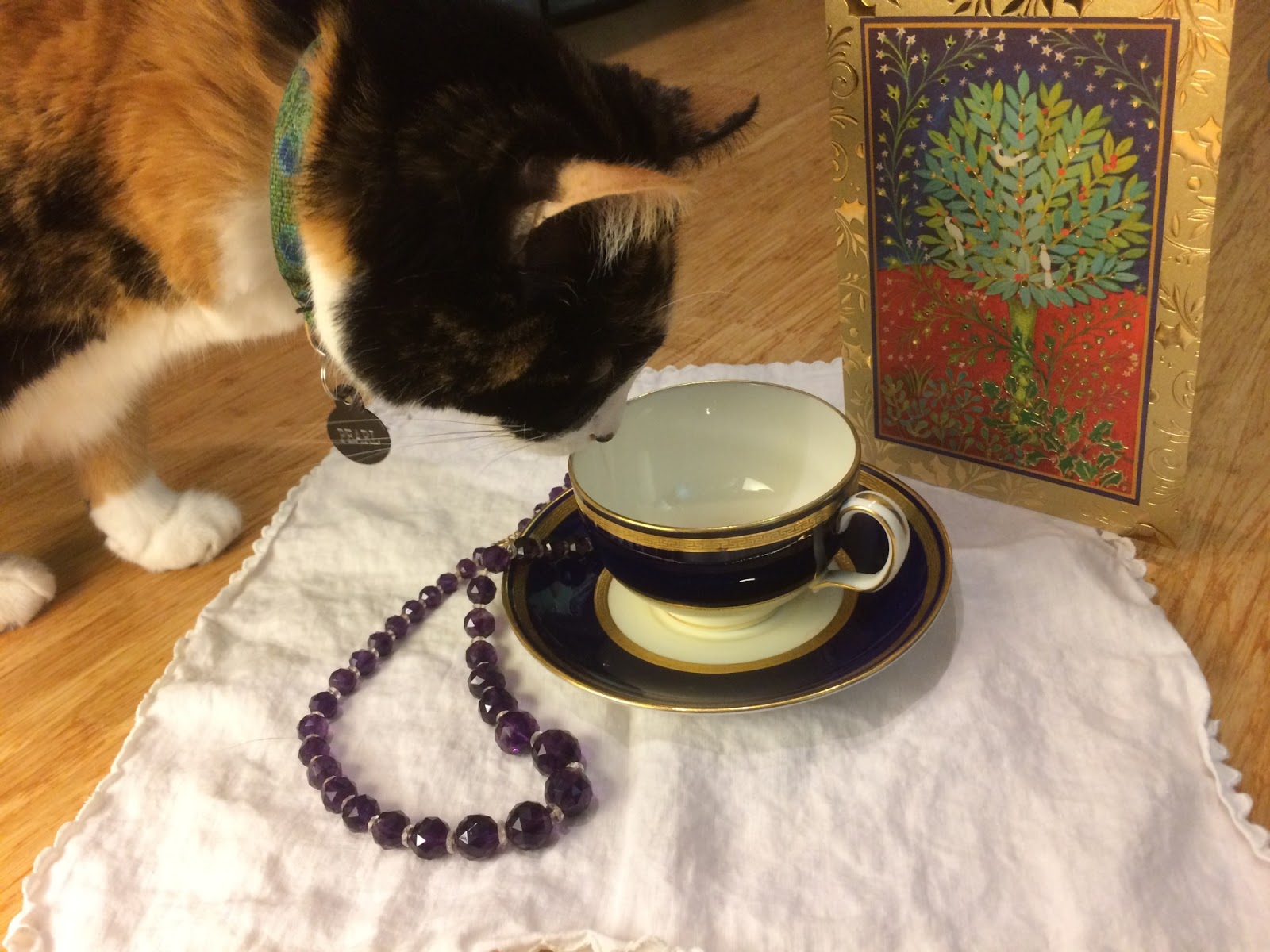
Cat sniffs the teacup on the white napkin near the necklace and Christmas card.
The cat investigates. Not in my novel, however.
Till next post.

Learning American Sign Language–it's interesting, challenging, and (as with most languages) probably easier if you aren't shy


Last spring, my daughter and I (and one of her friends from school) started taking a class in American Sign Language. Since this blog is about the interesting (sometimes shiny) things that grab my attention, I thought I’d mention some of the features that make this an exciting language, and also say something about my experience trying to learn what is, to me, a very unfamiliar language.
First, some of the things I find interesting about ASL. One of the most obvious is the use of space and direction of sign. For example, if the signer wants to say that she gave something to her mother, she can indicate that she is going to use the area to her left as the space for “my mother”, and then direct the movement of the “to give” sign to show that the signer is giving something to her mother. By placing “my father” to her right, she can describe an encounter between her mother and her father, neither of whom is there, without repeatedly signing “my mother” and “my father”. (If her parents were there, she could simply point to them.)

As well as using space in interesting ways, facial expression is very important. (Our teacher keeps reminding us of this—apparently we have relatively inexpressive faces most of the time.) Expression seems to play much the role that tone of voice plays for English speakers, plus more. I say “plus more”, because I think there might be some signs aren’t really complete without the appropriate expression. I’m not sure though—I think the teacher said that if you sign “sad” without a sad face, it comes across as either sarcastic (which would equate to deliberately inappropriate tone of voice) or confusing (which suggests that you didn’t really communicate what you meant).
Then there’s the fact that there is no “is.” The verb “to be” is basically non-existent. And here I thought “to be” was such a basic, crucial verb! Apparently Russian doesn’t have it, either. Our ASL teacher, who is a CODA (Child Of Deaf Adults), knows quite a few languages.
One final thing that is really neat—ABC stories. Many signs incorporate the same hand shapes used for fingerspelling. For example, “family” uses an “f” shape on both hands, and the hands make a circle. (Isn’t that a nice sign?) In ABC stories, the signer tells a story using signs that incorporate the hand shapes from A to Z, in order. We saw a Halloween ABC story on a video in which the thumb of the “A” was Dr. Frankenstein’s surgical slicing open of his creature’s skull (to put in the brain) and the final “Z” was the terrified doctor’s mad zig-zag as he fled the scene of his creation.
I said earlier that ASL is, for me, a very unfamiliar language. The only languages I know are spoken, and I’m not used to watching movements for that level of meaning. (I’m used to gestures for simple stuff, like “Over there” or “Come here” or maybe a sarcastic playing of tiny violins.) Sometimes it feels like my brain is burning from the attempt to focus and recognize the words as they are signed—and our teacher is signing at what is surely a v-e-r-y s-l-o-w pace.
As I get more familiar with the signs, I expect I will be able to recognize them faster and the sensation of my brain burning will fade. Also, maybe I’ll be able to catch more than the first and last letter of finger-spelled words (and the “h”s—for some reason, they grab my attention.)
I neglected to mention earlier that the grammar of ASL is completely different from English. That’s another challenge—figuring out the order in which I should sign so as to get across my intended meaning. John gave Jane an apple. Is it BEFORE-APPLE-JOHN-GIVE-JANE (with appropriate direction of ‘give’)?  Still not sure.
Our teacher keeps nudging us to go to DeafChat meetings and practice our conversational skills with ASL speakers, but she seems to have gotten an entire classroom full of introverts and shy people. (We have a class of about five, now.) She tells us entertaining stories about traveling to other countries and practicing her conversational skills, laughing at her mistakes and urging us to do likewise. She’s right, of course, but I have a hard enough time talking to strangers in English, never mind when I can barely get beyond my name, the weather, and my favorite food (chocolate). It’s been a problem with every language I’ve learned (some French, some Spanish). Eventually, I hope, my vocabulary and nerve will both be sufficient to give it a try.
Anyway, American Sign Language is pretty neat and I commend it to your attention. Try it–whether because you think it is cool, or because you want to learn about Deaf culture or work with Deaf people, or because you want to be able to talk to your friends during noisy concerts. Just don’t use it to give answers across the room during exams—no matter what my ASL teacher says.
She’s just being mischievous.

A hand finger-spelling the letter H.
For some reason, “H” stands out.

 Till next post.

Addicted to Story


I am addicted to story.
Poetic and dreamy as that sounds, the reality is not so rosy.
My first thought was actually “I am addicted to Netflix.” It was only after I’d given the matter more thought that I realized the problem goes much deeper.
This past year I spent a lot of time watching mysteries and detective shows via Netflix. This was partly due to having first one shoulder, then the other, freeze. Frozen shoulder meant that there were some months when my shoulder ached a lot and carrying out everyday tasks, like moving laundry out of the machine or putting away dishes, could get quite painful (especially if I knocked something over and tried to catch it with the wrong arm!). So I spent a significant amount of time distracting myself with Netflix. Sometimes I checked out audiobooks from our library. It would have been nice to spend the time catching up on reading, but repetitively turning or flicking pages seemed to result in worse pain later.
As I improved and could do more, I kept watching shows on Netflix. Sometimes it was sociable—I watched with my daughter. She knit or drew; I cooked or put dishes away. Or at least, I tried to.
Because that’s the point, the reason for this post. I cannot watch a mystery and follow a recipe without missing parts of the plot and, too often, missing parts of the recipe as well. It isn’t just the problem of turning away from the television either, though obviously that makes it easy to miss a crucial clue or facial expression. I’ve tried to clean while listening to audiobooks. There isn’t anything to look at while listening to an audiobook, but my cleaning still suffers noticeably.
The problem is that my mind cannot successfully follow a story and make decisions at the same time. If I am listening to find out whether the body in the coffin really belongs to the missing lawyer, I am not simultaneously deciding whether I ought to degrease the stovetop, or whether it would be more productive to clear the papers off the table. To decide that, I have to tear my mind away from the story—and while I do so, I miss part of the story. The story experience is weakened, and the cleaning takes much longer than it should.
The same applies to any task that requires attention. I had started a simple sweater that required nothing but knitting around and around for ages. That I could knit while watching a show.  Then I started a shawl in its place, because it was clear that I wasn’t going to be able to pull a sweater over my head for months, but I could still drape a shawl over my shoulders. (Eventually I had to stop work on the shawl, too, because the repetitive motion of knitting resulted in increased pain.)
But even though the shawl pattern was very simple and repeated only four rows, most of which were either straight knitting or straight purling, the shawl suffered from being worked on while watching Netflix. I kept having to rip back stitches because I’d missed the occasional yarn-over, or because I’d mistakenly been purling in a knit row.
So I know, from repeated and varied experience, that I cannot watch a movie (or listen to an audiobook) and simultaneously follow any but the simplest recipe or knitting pattern, or do any but the most straightforward cleaning (drying dishes, e.g.). I know this.
And yet, as I start wiping counters or pull out a soup recipe, I find I am filled with the urge to turn on the television and see if there is anything good on Netflix that I haven’t watched yet. Or maybe just watch a Poirot episode for the umpteenth time—after all, I can’t miss as much if I already know who did it. I really, really, really want to watch something! The idea of just cleaning or cooking, without the accompaniment of story, seems so… bland.
It wasn’t always this way.
Still, why am I calling this an addiction? It isn’t really, and the term gets thrown around much too casually already. I won’t suffer physiological withdrawal from leaving the television off. The urge to watch Netflix isn’t alienating me from my family—they like watching it, too. It isn’t interfering in my daily life… well, not much. Not unless you consider the number of hours I spent watching Midsomer Murders, all 116 episodes, even though it isn’t nearly as good as  Death In Paradise.
I’m saying “I’m addicted” because even though I know I can’t successfully combine watching shows with other tasks, I’m having a hard time keeping myself from trying to do so—over and over again. The lure is just too great.
Further, I’m saying I’m addicted to story because it doesn’t actually matter if the story comes in the form of video, audiobook, or paperback. Books tend to be less of a problem because I really can’t do anything else while reading a book, so I don’t try. (If it is an ebook, I can walk on the treadmill while reading it, but walking is automatic enough that I can do both successfully.)
Having said that, there are some situations where my absorption in a book does pose a problem.  If I start a book in the evening, I often don’t want to stop reading to go to bed. I stay up too late and don’t get enough sleep. That has happened many times.
Also, I tend not to be very responsive to my family when I am in the midst of a good book. My daughter will not let me forget one evening when she was young and I wouldn’t put down my book long enough to read her a bedtime story. I suspect I asked my husband to take over that one night so I could keep reading—I almost always did read to her—but that isn’t the way she saw it. That night, she and the book were in competition for my attention—and the book won.
Now we’ve reached the part of the post where, having outlined the problem, I propose a solution.
Umm, willpower?
Disconnecting the router?
A resolution not to watch/read/listen to any story that isn’t truly worthwhile, and to give my undivided attention to those that are?
Well, I’m still working on it. I would be pleased to hear from anyone else with a similar problem, especially if they have found a solution that works for them.
Till next post.
The much-abused pink shawl in progress.
P.S. In case you were wondering, that total is 174 hours of Midsomer Mysteries, or about a month’s worth of forty-hour work-weeks. And it wasn’t the only thing I watched.