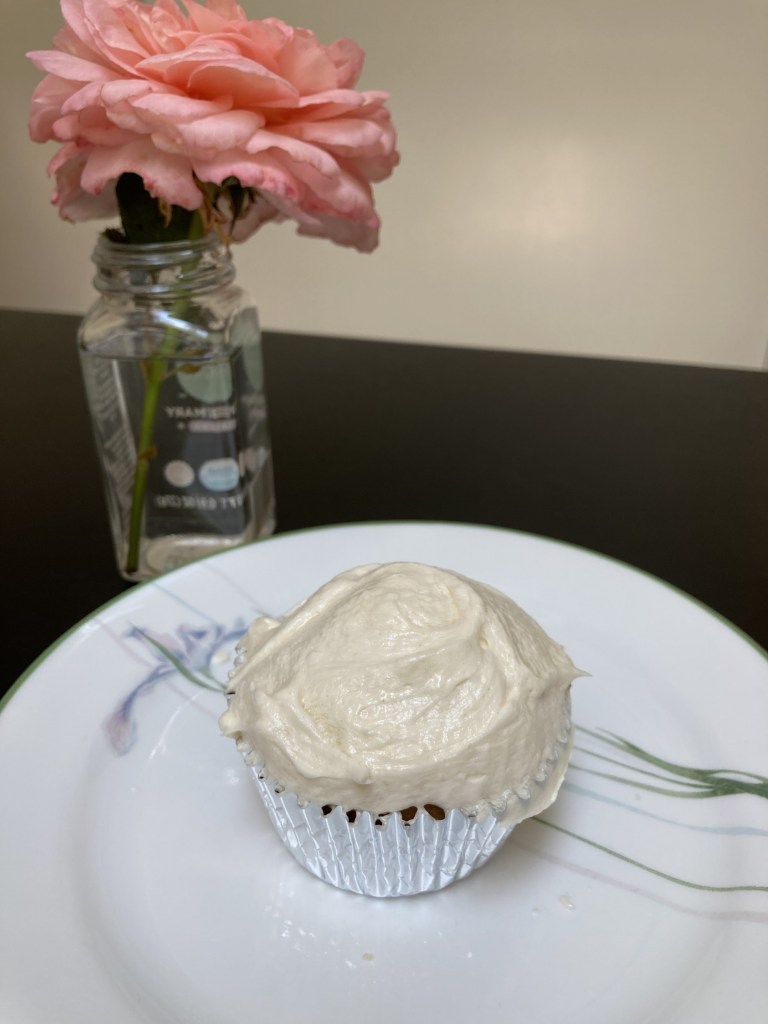
Trying an Old Family Cake Recipe and a New (To Me) Frosting

My Grandpere, my father’s father, was a baker. When we celebrated birthdays while staying with him and Grandmere, he always produced a cake. Not a chocolate cake, though. I’ve never actually known what sort of cake it was, other than that it had two layers, a sort of whipped cream filling, sliced almonds patted onto the sides, and–for my birthdays–a glossy, smooth, pink frosting.

I do remember that it was delicious, even if I’m not sure what it was flavored with.

I have one of my Grandpere’s cookbooks, Cakes For Bakers. It’s clear that he used it, and it’s full of scraps of paper with recipes. I say “recipes,” but “lists of ingredients with a title” is a better description. I know I’ve looked through them before, trying to find out what cookie recipe he used, but this time I was curious about the cake recipes. “Mace” showed up several times, particularly in connection with something called “wine cake”, but also in a few other places. What would it be like to flavor a cake with mace?
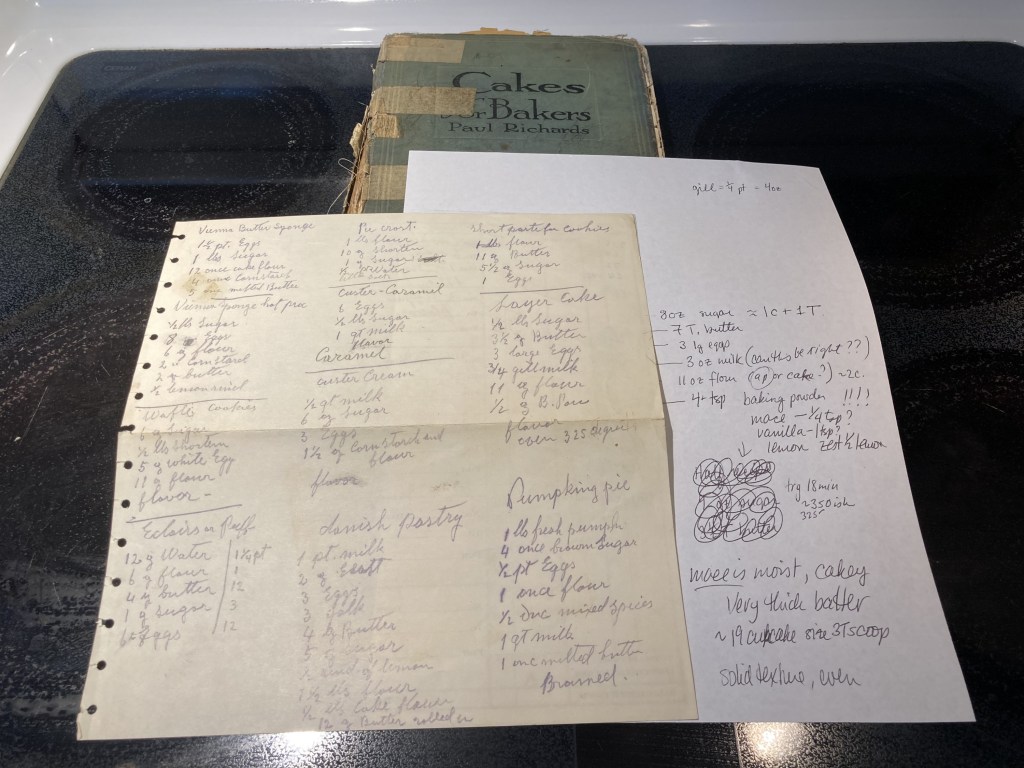
One of the recipes says “layer cake.” I decided to try that, but add the “mace, lemon, vanilla” that shows up in the context of the wine cake. Mace is similar to nutmeg, and I already know that nutmeg and lemon are a nice combination.

However, I didn’t want to end up with us having to eat a whole cake, so I decided I would make the batter into cupcakes so I could freeze some for later.

At the same time as I decided to try the cake, I also decided to try a new and unrelated frosting that I’ve been curious about–Ermine Frosting, which involves boiling milk and flour together. (It also has a lot of butter.) So, not one but two experiments–perhaps not as tightly linked as they should have been.

First, the cake. I deciphered and “translated” the measurements (what’s a gill?) and tried using the standard approach for a butter cake, creaming the butter and sugar, adding eggs, then alternating the flour mixture and milk. I guessed at suitable amounts of mace and lemon and vanilla. The result was a thick but tasty batter, and cupcakes with a fairly firm but good crumb. The flavor of mace was pretty strong–perhaps I should have gone heavier on lemon and lighter on mace.

The ermine frosting was intriguing. Some methods have you beat the butter and add the thickened milk/flour mix to it, while others have you add the butter to the thickened, beaten milk/flour mixture. I used the recipe from King Arthur Flour’s website, and heated milk with flour and sugar to make a cooked paste, then beat it till it cooled down some, then added butter. The texture is very smooth and buttery (no surprise that it is buttery) and I think it would be good with flavors besides vanilla. It reminds me of the texture of the filling that Phoenix Bakery in Pittsboro, North Carolina, uses in their doughnuts–silky with butter.

However, vanilla ermine frosting doesn’t seem a good match for these cupcakes. I’m not really sure what would be–something citrusy? Cinnamony?

This brings me back to the fact that the flavors–mace, lemon, vanilla–seemed to be connected to wine cake. In the cookbook and in the notes, the recipes for wine cake do not contain any wine. Is it so named because it is accompanied by wine? Or is there supposed to be wine involved later on?

When I looked up “wine cake” on-line, every recipe I found did in fact include wine as an ingredient (and often, cake mix and pudding mix.) So why is this cookbook’s “wine cake” so different? Why can’t I find out anything about the origins of this wine cake?

The internet can tell you a lot, but some mysteries resist easy answers. I should have asked more questions of my Grandpere, but I wasn’t interested in baking back then. I should have asked more questions of my father too, when I started baking, though I’m not sure how many more answers he could have provided. Maybe he didn’t ask those questions of his father either.

If you know anything about a “wine cake” that doesn’t contain wine but does contain mace, I’d love to hear from you.

Till next post.

Games as practice for life–losing

Two games we have been playing recently, and a tray for rolling dice.

These past few weeks, we’ve been playing a new game, Fantastic Factories, as well as the old favorite, Ark Nova.* I always find learning new rules difficult at first, and maybe that’s why my mind went back to games as practice for life. In this case, as practice for losing (though I’ve been doing pretty well with Fantastic Factories so far.)

Let’s face it–losing is disappointing. It’s more fun to win. And yet, unless you are playing a cooperative game, someone is bound to lose and it may be you. So you have to be able to lose well. You need to be able to lose without either acting out (like a petulant child) or giving up on the game altogether.

Acting out is particularly bad. No one likes a sore loser. This is one of the more obvious lessons kids learn from playing games, along with taking turns, following rules, and being a gracious winner. If you are known for upsetting the board when things don’t go your way, other kids won’t want to play with you. (Talking to you, Ali B.!) This is clearly true in life as well. (And now I’m looking at some politicians…)

Only a bit less obviously, you need to be able to lose and not give up on the game. If every loss is so upsetting that you refuse to play again, you miss out on the fun you can have in playing. You also miss out on the opportunity to get better at playing and so start winning some games.

Similarly, in life every skill you learn starts off with you doing very poorly. For example, if you’re trying to get published, well… how many agent-rejections am I up to now? Sixty? Eighty? More than one hundred? (It’s still early days.)

So what helps a person lose well? Here I’m going to digress a bit. In games where you are focused on building things or completing projects, and where winning is mostly about being more successful in your projects than your opponent, it is perhaps easier to deal with losing because you can still feel you were very successful. It’s just that the other guy was even more successful. In games where the competition is more direct–you can’t both take the same trick in a card game, for instance–your current status if you are losing feels more sharply obvious.

One thing that helps is perspective. It’s just a game. There will be other games.Obviously this is not true of life, but in life, particular episodes of loss are just that–episodes. There is more to your life than this one loss.

Hope also matters. It’s hard to have fun when things are clearly going badly for you, when all your plans and stratagems are being frustrated. So long as you feel, “But I can still win!”, you have hope. At some point, depending on the game, it may become obvious that you are going to lose. But if you can reasonably think, “Well, next time I will do this differently…” then you still have hope, even if it is no longer focused on the game at hand.

So losing in games is practice for losing in life. I’m not suggesting that this is why people should play games. That would be like suggesting people should eat broccoli because it is nutritious, instead of because it is (when properly prepared) delicious. No, you should play games because they are fun. And like anything else in life, some games will appeal to you more than others. So my point, I suppose, is that you should seek out games that appeal to you and those you play with, and play them.

And practice losing well.

Till next post.

*Because sometimes you don’t have time for a three hour game.

Morality in Fictional Worlds–as the author wishes

Does fiction help us understand morality?

Philosophy professors like to use thought experiments to get their students to look at their assumptions in a new way, or to bring out their intuitions about conflicting principles.

“Could I be a brain in a vat?”

“Should I reroute the trolley so it hits one person rather than five?”

“Should Heintz steal the medicine for his wife from the greedy pharmacist?”

And always, “Why?”

Sometimes philosophers use situations from familiar books and movies to serve the same purpose: Sophie’s choice, McCoy’s aversion to the transporter on Star Trek, Huck Finn’s decision to go against what he believes is “right.”

Focusing on a vividly described situation makes for interesting discussion, but it’s important to remember how fiction differs from reality. In fiction, the author determines which details are relevant, what consequences ensue, and how the world works.

One such relevant detail is where the story “ends.” End the story too soon, and all the hero’s efforts seem have resulted in disaster. End it just after he succeeds, and it seems that he made the right choices after all. End it too late… well, it’s up to the author whether he really lives happily ever after as a result of his decisions. That brings us to the author’s control over what consequences ensue.

For instance, suppose you have a film in which the good guy and the bad guy end up shooting at each other. Which shots hit their mark? Which injuries are fatal or incapacitating? In westerns and the Marvel Universe, the results tend to favor the hero, because the author controls the consequences.

You can also see this as a fact about how these worlds work, something else the author controls. In these worlds, the good guys are more adept at fighting than the bad guys. It isn’t very plausible, unless maybe God is on their side. After all, surely the bad guys attack people more often. Even if the good guys have self-discipline and practice devotedly, they will have less battle experience. So why would they win so consistently?

(In the long run, the good guys have the advantage of working together and trusting each other, but that isn’t going to make their aim more accurate.)

In the world of Dr. Who, guns are not the answer. Dr Who also faces bad guys who are armed with all sorts of weapons, but he (or she) relies on finding alternate ways of dealing with them. And he succeeds. There is always another way to solve the problem.

I would like to believe that this is true of our actual world–that there is always another solution– but I don’t know how we could tell. The writers of Dr. Who can ensure that the good Doctor does find that other way. We don’t have a Doctor to call on.

In some worlds, this other solution involves the Power of Love. Star Trek Discovery, season 3, seems to exist in such a world. The bad guys are not really bad after all, just misguided, unhappy, or perhaps even right about having been mistreated. And there is something to this, as anyone who has been caught between two feuding friends can agree. In these worlds, with the right approach, the two sides can be reconciled and be friends.

I would like to think that this is also true of our world, but it seems clear that there are some people who really don’t care about others. There are even people who actively enjoy hurting others, and not because they believe the others have wronged them. The Power of Love seems inadequate here, at least without some sort of psychiatric fix that we don’t currently have.

Even when the enmity is between two basically decent people or groups of people, reconciliation is much, much harder than it appears in fiction. People tend to see all the ways in which they have been wronged, but only a small percentage of the ways in which they have wronged others. (I don’t remember the name for this bias.) So people feel that they are being asked to accept more cost and forgive more injury than the other side. Even when it’s clear that the dispute is hurting everyone, it is very hard for people to accept less than they feel they are owed. And if resentment continues to burn, the dispute is likely to flare up again at a moment’s notice. One can only hope that the next generation doesn’t inherit all the resentment of the past.

Does fiction help us understand morality? As an author, I can show a world in which it is sometimes necessary to kill, or a world in which there is always a better way. My characters may need to do bad things in order to prevent worse ones, or my characters may need to stick to their principles and refuse to do wrong, no matter what, lest they become part of the problem themselves. The bad guys may be misunderstood, or they may truly be bad.

How does this help with the real world? When I’m addressing some real world situation, I may have the Dr. Who universe in mind, while someone else is thinking about the Marvel Universe. No wonder we disagree about what to do! Which of the many fictional worlds is most like our own? Tony Stark’s New York? Dr. Who’s London? The Federation of the far, far future? Something else?

Yes.

One thing fiction does help us do is see the different ways that other people–and ourselves, at different times–perceive the world. It can help us understand why we draw such vastly different conclusions about how to react. It cannot, however, tell us what is right.

Till next post.

P.S. Though I used science fiction for my examples, the same contrasts exist in novels and films set in strictly realistic settings.