Hope–in poetry, fiction, and life

Let me start by sending you to a poem, “Hope” by Rosemerry Wahtola Trommer.

Now that you’ve read what it says, so nicely and concisely, I’m going to talk about hope at more length.

Hope leads us from where we are, a place where we can’t see how things are going to work out, to that unknown future where, quite possibly, things really do work out. We can’t know in advance what that future will look like and there are no guarantees–except perhaps that if we don‘t keep moving, we will never get there.

There are two things I want to say about hope. The first is that sometimes we despair because we think we know more than we do. We think we know what is required to save the day, and also that we are unequal to the task. So we lose hope.

In The Lord of the Rings, Frodo is faced with a nearly impossible task. Go to Mordor? “One does not simply walk into Mordor”, as the popular quotation from the movie goes. Much less does one walk in while carrying the One Ring and hope to escape detection long enough to drop it in Mount Doom.

But Frodo accepts the task anyway, “though I do not know the way.”

You know how the story goes. There are others who can show him the way, even the way into Mordor. Help comes from unexpected sources, and in very unexpected ways. Frodo can anticipate none of this. And as he plods forward through the hostile wasteland that is Mordor, he has no way to know that in the White City, Aragorn has learned Frodo is alive and is planning desperate measures to keep Sauron from looking his way.

The day always needs saving, from one threat or another, but you aren’t responsible for saving it. Only for doing your bit.

The second thing I want to say about hope is that it is amazing what we can accomplish together when we have a clear, urgent goal.

Here I’ll move into real examples. Remember the Tham Luang cave rescue? (If not, there are documentaries you can watch.) Twelve kids and their soccer coach were stranded in a cave in Thailand. The Royal Thai Navy Seals and expert divers and rescue workers from all over the world put their skills to work to get them out. The route was long and incredibly difficult, and one diver died in the process. But they did get the kids out.

And then there are the Covid vaccines. People all over the world poured knowledge, skills, and funding into the effort, and the vaccines were developed faster than we had any reason to expect. Death rates dropped, and family gatherings recommenced.

Working together is harder when the goal isn’t as clear as “get the kids out of the cave” or as urgent as “because huge numbers of people are dying daily right now and all our lives have been turned upside down.” But hard isn’t impossible. And again, it isn’t all on your shoulders. Other people are also at work.

To be clear, these examples could have gone very differently. The kids could have died in the cave or on the way out. We could still be waiting for a vaccine for Covid. The point is not that we always succeed when we devote ourselves to a task–we don’t–but that we sometimes do manage incredible feats. Therein lies hope.

I’m going to end with a couple of lines from a song. I like these lines because they seem counterintuitive at first. So, from “Trip Around the Sun”, (I prefer Jimmy Buffet, but here’s Stephen Bruton as well)

“I’m just hanging on while this old world keeps spinning.

And it’s good to know it’s out of my control…”

Can you imagine being responsible for keeping the earth spinning?

Till next post.

P.S. I want to thank the neighbor around the block who periodically inscribes poems on the sidewalk in chalk. I think this started during the pandemic, and I have enjoyed both the poems I recognized and the opportunity to discover some new favorites. “Hope” is a new favorite.

Cat Dreams–what do cats dream about?

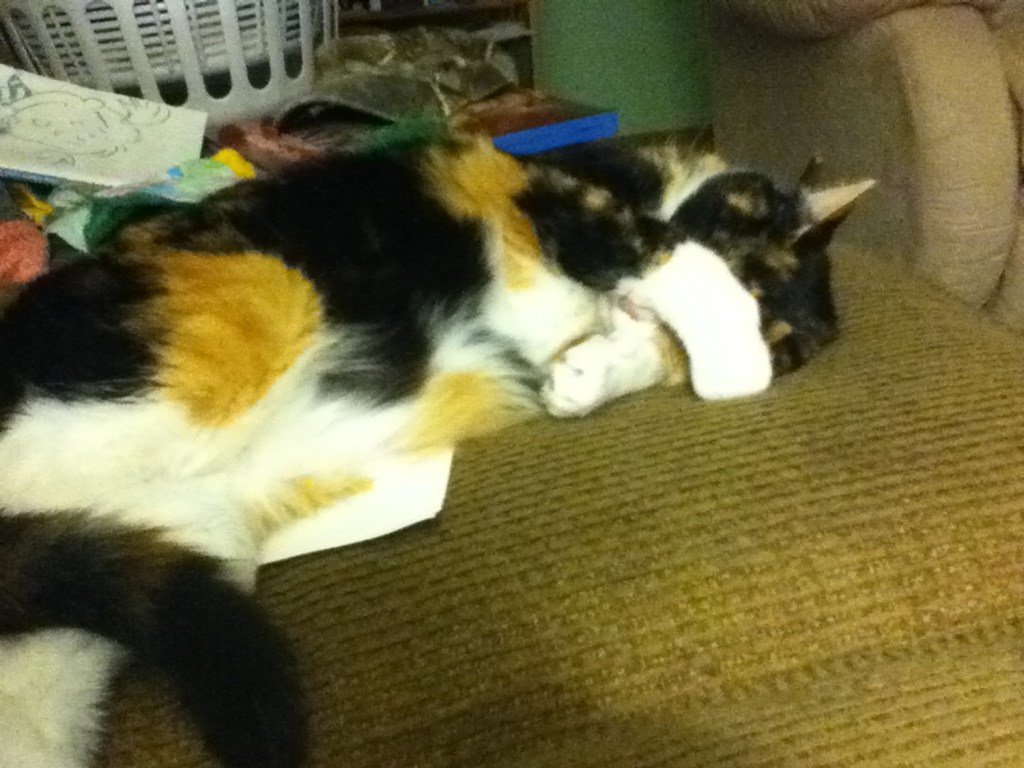
I know my cat dreams. It isn’t just that she’s a mammal, with a brain much like mine. It’s because sometimes, as she sleeps on my lap, her paws twitch and she mumbles that chirping, chattering sound she makes to birds on the other side of the window.

So she probably dreams about birds in the garden. What else do cats dream about? I imagine she dreams about other things that happen in her life. Maybe she chases lizards, or washes herself, or eats delicious wet food.

Does she dream about things that haven’t happened? The vacuum has never left the closet of its own accord and chased her around the house, but does she have nightmares about that happening? Or does imagining things that haven’t happened, even in dreams, require some quality that cats’ brains don’t possess? Maybe she has bad dreams of going to the vet, of being poked with small pointy sticks, but none in which inflated garbage bag creatures pounce on her in the kitchen.

Maybe that’s a good thing.

What is it like when she gets woken up mid-dream, perhaps by some over-affectionate human wanting to pat her? When I wake up abruptly from a dream, sometimes it’s hard to shake the feelings I had, especially if I was angry at someone, or very upset about something that happened in the dream. And I know that it was a dream, and know the difference between dreaming and reality. How do cats know the difference between a dream and reality? Or does it not matter–does whatever they felt in the dream get immediately replaced by their awareness of their waking surroundings, so that the dream fades from thought almost instantly?

What is it like when cats dream? I can only guess.

Till next post.

Fight With a Foxtail Fern

When I decided to move the foxtail fern out of the house, on the grounds that it is apparently toxic to cats and sheds a lot of needles even if kept out of reach, I did not realize what a fight I would have to reclaim the pretty pot I had planted it in.

First I tried to wiggle it out of the pot dry. It resisted–strongly. So I thought perhaps watering it would help ease it out. That may have been a huge mistake. The plant continued to remain firmly fixed in the pot, despite my sticking wooden skewers along the edges and wiggling them in an attempt to loosen the roots. I pulled. Not the slightest movement.

I got my husband involved. He stuck a sharp trowel in, moving it around as I had done the skewers, trying not to scrape the glazed interior of the nice pot that I wanted to save. But the trowel wouldn’t go in very far, so finally he pulled out the weapon of last resort–a butcher knife with a slightly curved end–and proceeded to cut the plant out. (By this time I was mainly concerned with saving the pot, not the plant.)

Success! We reached in to find out how the plant had stuck itself so thoroughly to the pot, and found that the remaining roots came out easily. They weren’t attached at all–they were just well and truly packed in there. Watering the plant had, if anything, caused the water-storing tubers to expand and wedge the plant in even more tightly.

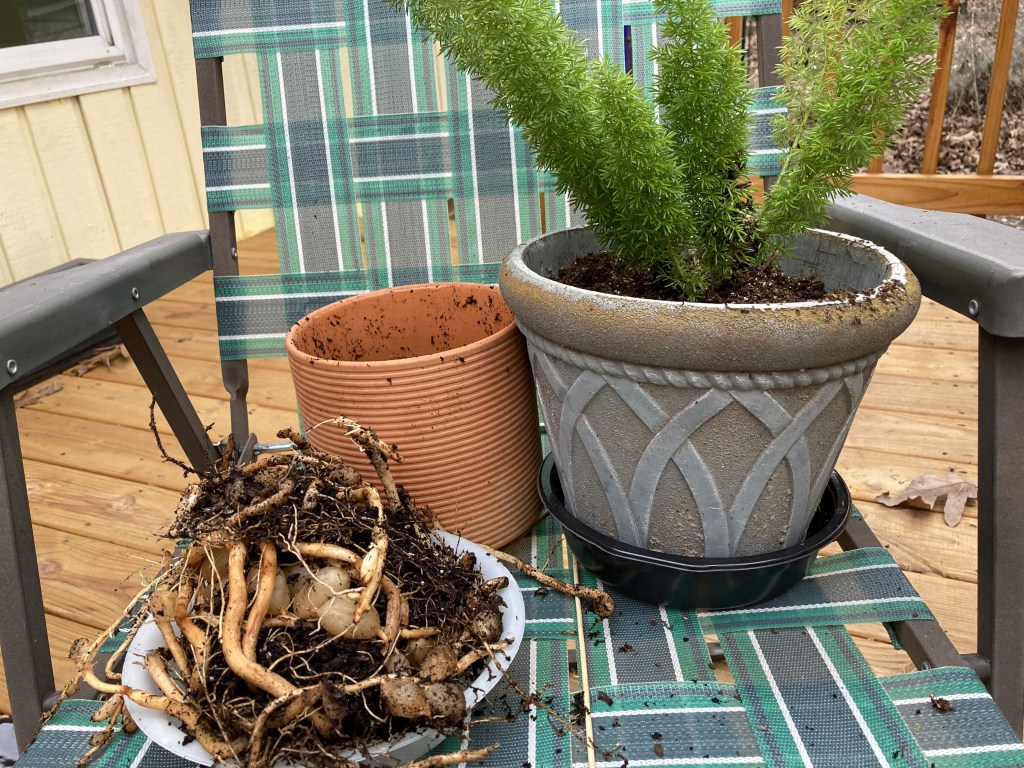
To understand, see the loosened mass of roots and tubers that I pulled out of the pot after the drastically root-trimmed plant had been put in a different (and slope-sided) pot.

Foxtail fern and its roots

It’s hard to imagine it fitting in there.

As a side note, I do generally prefer a bit of slope to the sides of a pot. I dislike pots where the rim comes inward at the top and makes it more difficult to tip out a pot-bound plant. But the terra-cotta pot in question had perfectly straight sides, so I wasn’t expecting a battle.

I shall now put the plant out on the porch, where the cats are not allowed. We’ll see whether it survives its drastic pruning, and if so, how it manages the rest of the winter. It’s February–there’s supposed to be some winter still to go, whatever the blooming daffodils think.

Till next post.