#CarolinasKidLit2022 —lessons in marketing

I’m delighted to be at the SCBWI (Society of Children’s Book Writers and Illustrators) conference in Charlotte, after two years of attending only virtual writing events. I was worried for a while that the weather might intervene, and decided to take the train down rather than chance driving in a lot of rain. I hate driving in heavy rain.

The first session I found myself in was about building an online kidlit platform. Thank you, Micki Bare, for a thorough look at the various forms on online presence and the ways in which they differ. Also, I didn’t know you could make a Facebook page that was accessed separately from your personal FB stuff. I’ll have to look into that.

But if you’ve read my earlier blog post Too Many Books, Too Little Time—writers want to write, not do marketing, you know that marketing is not my forte. In fact, I have complained loudly that I want to write, not spend time coming up with interesting tid-bits for strangers online. Yet I do recognize the difficulty of just relying on writing a good book to get people’s attention when we live in a world that is FULL of very good books already. And yes, people do spend a lot of time looking at what other people say online, so there’s an opportunity there.

I’m usually good about doing whatever exercise the speaker assigns—write something about a past experience, list five children’s books that you wish you’d written, that kind of thing. But “Take a silly selfie and post it using the following hashtags”? I started to take out my phone, then thought—wait, I don’t do Twitter. I don’t even want to do Twitter. Where else can you post with hashtags? (Answer—Instagram, apparently, but I don’t have that either.)

As you notice, I’m now experimenting with using a hashtag in the title of a blog post. Will it actually be recognized as a hashtag? I kind of doubt it, but it makes a good title.

All of the above is actually a preamble to some thoughts I had while waiting (and waiting and waiting) for my restaurant check. (I think the weather meant they had more diners than they are used to—either that or the weather left them very understaffed.)

Why can’t writers just hire someone else to do all the marketing stuff without any involvement from them? The answer, presumably, is that people want to read something personal, something that is actually about the author or has some connection to the author’s life. But why? The author is not the book character. The author may or may not be a terribly interesting person. (Everyone is interesting to some degree, but why should an author be any more interesting than your next-door neighbor?)

It’s unfair, I thought. Authors didn’t always have to put themselves out in public to this extent. One used to be able to write and still be a private person.

Then I thought—what about actors?

An actor isn’t the character he plays in the movie, but actors have always known that publicity was a crucial part of being an actor. People expect at least some engagement from them, or that they will at least tolerate a lot of gossip about themselves—maybe even go out of their way to create some interesting rumors. The crucial difference seems to be that actors are SEEN. They tell their stories with their faces and their bodies. And that has always made them very interesting to the people watching their films, unlike authors, who are unseen creators. The actor’s appearance in a film creates interest in the actor—something which doesn’t happen nearly as much with books.

Studios know that interest in a particular actor creates interest in that actor’s films. So I guess managing and encouraging that publicity becomes part of the job. Publishers want authors to generate interest in themselves, but they want them to do so even before the book creates any interest in them.

I’m not sure what to conclude from this. That authors need a new conception of their role? That they should hire publicity people to do all the tweeting for them? That the whole system seems really unsustainable in a world of seven billion people connected by internet?

I don’t know. I do know that I need to get some sleep, because tomorrow starts early and there are still many exciting sessions to attend at #CarolinasKidLit2022.

Till next post.
Kids Away From Home–why we love stories about boarding schools

November approaches and with it, NaNoWriMo–National Novel Writing Month. This year I have an idea for a middle-grade fantasy about a special boarding school. There are plenty of stories about magic boarding schools, but what if you’re a kid who can’t do magic in a world where almost everyone else can?

So far I’ve found one book about a non-magic school in a magical world. In Ordinary Magic, by Caitlen Rubino-Bradway, our protagonist is just getting ready to celebrate her twelfth birthday and her magical coming-of-age. After being evaluated for her level of magic, she can finally begin her magical education. Except… turns out she doesn’t have any magic. At all.

As a side note, have you noticed how many books start off with a testing or sorting of the main characters? From Harry Potter to Divergent, we can’t seem to get enough of putting people into groups. In our real lives, we have the much less exciting end-of-grade tests, SATs, and maybe some career counseling assessments. I think we are really fascinated by tests, especially those that could change the direction of our lives.

Going back to Ordinary Magic, I’m not going to say much about the story itself, except that the non-magic kids in Rubino-Bradway’s world face a much tougher time than I’m planning for mine. It’s a good book, and a nice twist on the magic boarding school idea.

So far, that’s the only book I’ve found about a boarding school for non-magic kids in a mostly magic world. By comparison, there are tons of books about magic boarding schools. I’m just going to mention one I read recently: A Deadly Education by Naomi Novik. It’s unlike most of the other magic boarding school books I’ve read in that there don’t seem to be any teachers, at least not any human ones. So all the characters are students, and they have to be very independent and resourceful in order to survive their school days.

Literally. The title says it all. This school has a very high fatality rate. And yet, despite the wide range of magical nasties they have to contend with, whether gloppy, spikey, tentacle-y, or toothy, the tone of the book was pleasantly wry and gently humorous. I don’t like horror as a rule, and while this book has a few gruesome moments, I didn’t find it grim. And I really liked the main character.

On to the more general question–why do we like books about boarding schools? One obvious answer is that it gets the parents out of the story. They aren’t there to protect their kids, keep them from doing reckless things, or interfere with their social lives. Kids in a fictional boarding school get to be independent to a much greater extent than most real kids get to be be, and this allows for some grand adventures.

(Parents in these stories don’t get to hover over their kids to get them to do their homework, either. The kids do it themselves or suffer the consequences. Parents, take note.)

The second appealing thing about these books is that school is a very familiar setting for kids, but at the same time, homework, teachers, and tests can be interestingly different in a magical world. Consider magical duels. How often do you get to face your classmates in combat as part of school? Spelling bees just aren’t the same thing.

Finally, the setting allows for kids to have adventures at all hours of the day. A boarding school encompasses a lot of different settings within it–the dorms, the classrooms, the dining hall, the library, some sort of outdoor area–and these are all accessible (more or less) all the time. The story doesn’t have to take a break while students go home to eat dinner and sleep. Instead, students can sneak out of bed and explore hidden passageways down in the kitchens or hold secret meetings with friends in the girls’ or boys’ bathroom.

The more I think about it, the more I’m looking forward to trying my hand at a (non) magic boarding school book. Only a month to go!

Variations on a Banana Muffin

One of the things I really appreciate about basic recipes, such as a basic banana muffin recipe, is that I can mess with the flavoring and see if I like the result.

I don’t add nuts to banana muffins. As a kid, I didn’t like nuts in baked goods. For that matter, I didn’t really like any nuts besides peanuts, period. That’s changed. I now really like nuts with chocolate–not just hazelnut, but pecan, almond, and even walnut. I even like almonds with green beans, and walnuts in spinach salad with craisins, just like a real grown-up. And chocolate-pecan torte is now my preferred birthday cake (the pecans are ground, not chopped). But I still don’t like chopped nuts in most baked goods.

On the other hand, I have always been enthusiastic about chocolate, so I frequently add chocolate chips to banana muffins (and to oatmeal cookies, and to oatmeal, for that matter.) Sometimes I add orange zest as well as chocolate chips, or by itself. Banana and orange is a good combo. Banana and orange and chocolate are great.

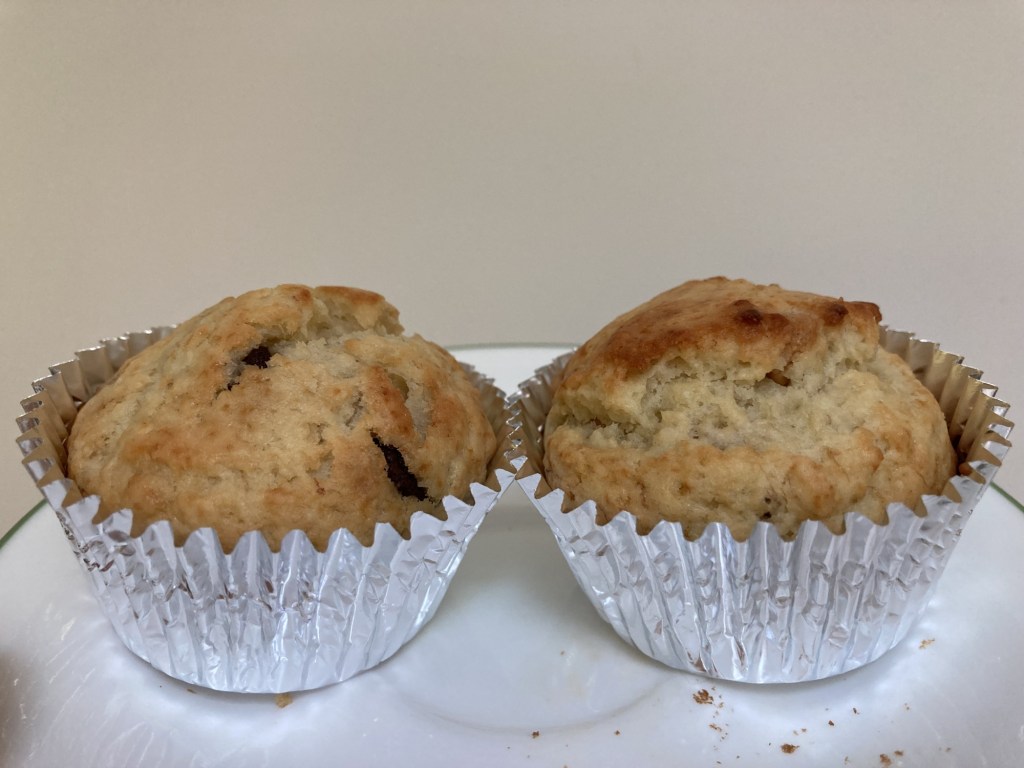
I had four overripe bananas, just enough for two batches of basic banana muffins, and some leftover peanut-butter chips in the pantry. So, in the spirit of experimentation (and because bananas and peanut butter go together so well), I made one batch with chocolate chips and the other batch with peanut-butter chips.

Here you probably expect me to rave about how delicious peanut-butter chip banana muffins are. And they did taste good, but I didn’t think they were anything to get excited about. My husband actually liked them more than I did. I thought they were… subtle. Good, but I could barely identify the added flavor as peanut. That surprised me.

And that’s why it’s fun to try adding flavors to basic recipes. You just don’t know for sure how you’ll like the result till you try it. I really expected the peanut flavor to jump out more. But now I’m eager to try something different the next time I make banana muffins–vanilla. There’s no vanilla in my basic banana muffin recipe, and vanilla is delicious in a banana milkshake. But I’m not going to stop there. I’m going to add spices as well, probably nutmeg, maybe cinnamon, maybe even cardamom. No idea how the cardamom will turn out.

You don’t really need my banana muffin recipe, since you can find a perfectly good one with no trouble at all, and maybe a better one than mine. But I’ll copy it here anyway, in case you’re curious. It’s from the 11th edition of the Better Homes and Gardens New Cook Book (the one with the plaid cover.)

Banana Muffins

Preheat oven to 400.

Grease or line 12 standard size muffin cups. (That is to say, neither jumbo nor mini size. I like foil liners because they peel right off without stealing any of your muffin.)

Mix dry ingredients in a big bowl.

  • 1 3/4 cups all-purpose flour
  • 1/3 cup sugar
  • 2 tsp baking powder
  • 1/4 tsp salt

Squash two very ripe bananas with a fork, hopefully resulting in 3/4 cup well-mashed banana. Mix wet ingredients in a separate bowl or large measuring cup. I suggest this order:

  • 1 egg, beaten
  • 1/2 cup milk
  • 3/4 cup mashed banana
  • 1/4 cup vegetable or canola oil

Add the wet to the dry, along with

  • 1/2 cup nuts (except I would never add nuts–I’d rather add 1/2 cup chocolate chips)

Mix gently with a spoon till all combined. Scoop into muffin pan and bake about 20 min till golden (or 18 in my oven, which tends to run hot.)