The Idea of Soup


It’s cold outside and there’s a thin layer of snow on the ground. January. My mind is filled with The Idea of Soup.
Really, I should say it is filled with My Idea of Soup. Yours may be quite different. My Idea of Soup tends to be filled with chunks of vegetables, possibly also with beef but not chicken, and garnished with chopped parsley. I don’t think I ever actually garnish soup with chopped parsley—I rarely remember to add parsley at all. But in My Idea of Soup, there is fresh green parsley.
My Idea of Soup. Where did it come from? I can think of several sources.
One is my favorite jigsaw puzzle, “Cubbyhole Cottage.” I was six or seven years old when I received it—my younger brother got a 60 piece puzzle with a jet plane on it. We used to have competitions to see who could put their puzzle together faster.
Cubbyhole Cottage jigsaw puzzle by Springbok
Cubbyhole Cottage, by Springbok
I liked to imagine myself as one of the people living in this old-fashioned house. Most often, I imagined myself as the girl in the purple dress and cap—the one stirring the soup. She seemed like the most important person in the house, as she was making the meal. The others were tidying, or setting the table, or watering the flowers, or just playing. Not nearly as important. Also, I liked the girl’s ruffle-edged apron.
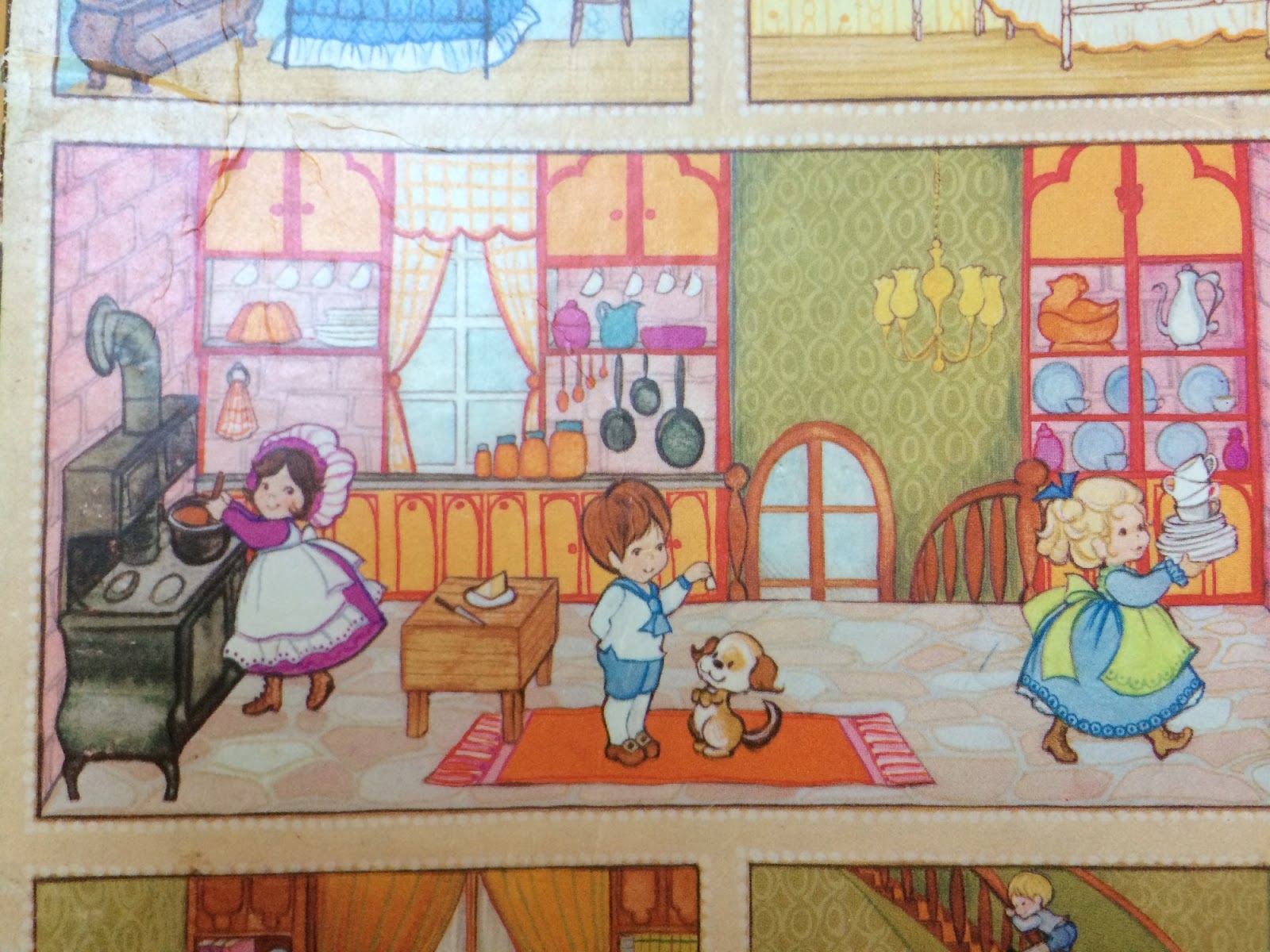
Close-up of kitchen in Cubbyhole Cottage jigsaw puzzle
The hearth is the center of the home, even if not quite the center of the puzzle.
Another source for My Idea of Soup is a story by Margaret Wise Brown, “Mister Dog”, in a book of bedtime stories from long ago. The illustrations are by Garth Williams, one of my favorite illustrators.
The story is about Crispin’s Crispian, a dog who belongs to himself. One day, after various adventures,  he meets a boy who belongs to himself and invites the boy to come live with him. They stop by the butcher shop on the way home, and the dog buys a bone while the boy gets a lamb chop and “a bright green vegetable.” The dog makes soup and gives some to the boy, who contributes some of his bright green vegetable to the soup.
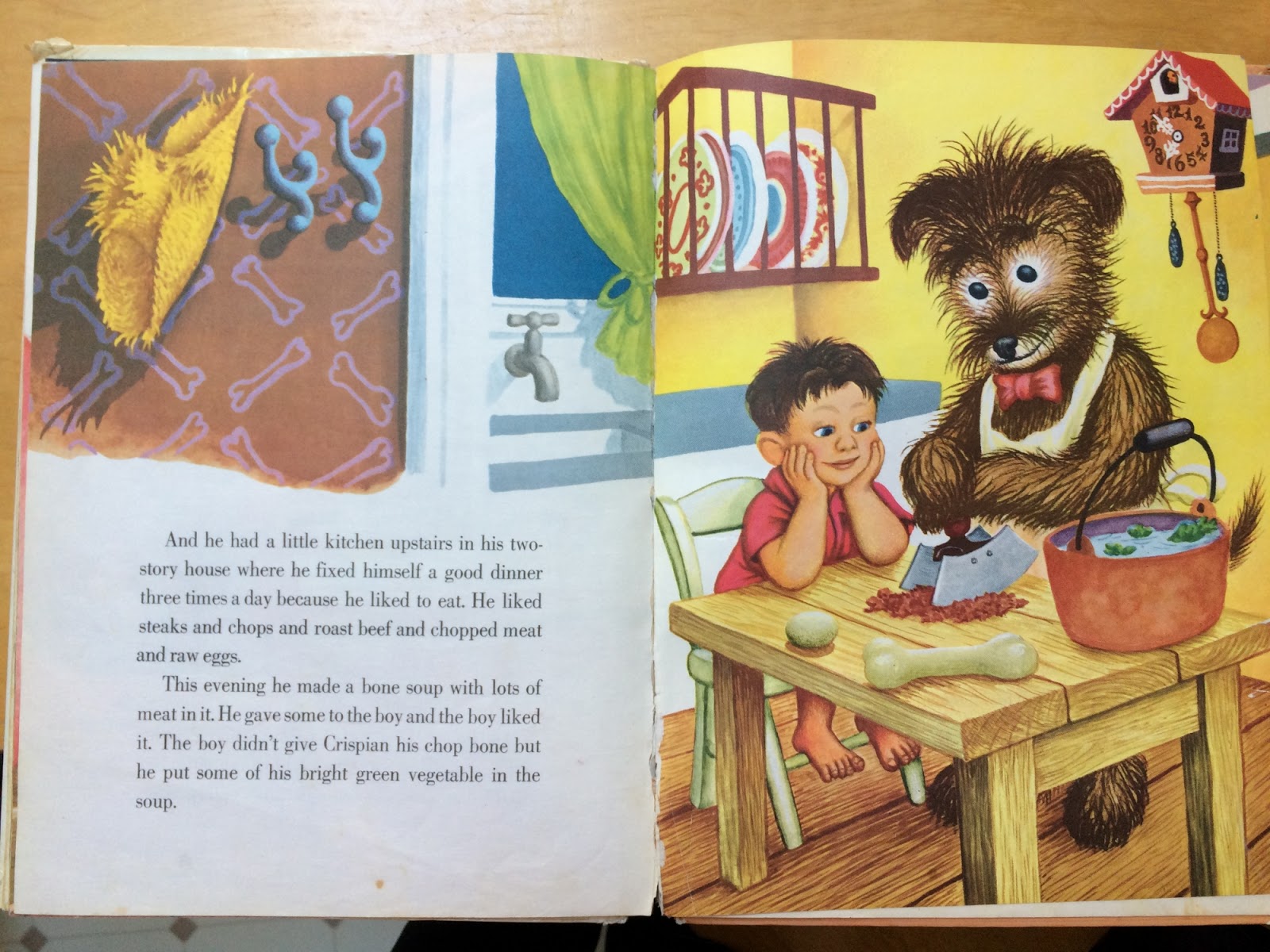
Page from Mister Dog, showing boy and dog with soup and green vegetable
See the bright green vegetable in the soup? Also, I love the cuckoo clock.
And now you know why My Idea of Soup is garnished with fresh parsley.
Finally, there is the old story of Stone Soup. There’s something appealing about all those people contributing a bit of this or that to the pot, and ending up with a tasty, nourishing soup “from a stone!” I love that idea.
Alas, in practice I’ve found that adding random vegetables to my soup tends to work about as well as mixing a lot of random paints together. The result is muddy and not particularly appealing. Even when I try to stick close to basics, the results are variable. However, the following ingredients generally work for a “Parsley, Sage, Rosemary and Thyme” soup (except that as I said earlier, I tend to forget the parsley.)
·         Some chopped onion, usually sauteed in a bit of oil first
·         Bite-size stew meat, dusted in flour and browned a bit before adding liquid (now cooked on the side so the rest of the soup can be vegetarian—but add some broth to the meat to take advantage of the browned bits on the pan)
·         Canned diced tomatoes with liquid
·         Carrots, diced or bite-size as you wish
·         Water as needed
·         Potatoes, in bite-size pieces
·         Salt and pepper
·         Sage, rosemary, and thyme
·         Parsley, either dried with the rest of the seasoning, or fresh and added at the end
Sometimes I add a bay leaf or a splash of soy sauce. Sometimes, if it doesn’t need to be vegetarian, I add a dash of Worcestershire sauce. I’ve tried adding mushrooms, but results vary. Sometimes I add some broth along with the water, but I don’t like the way a lot of vegetable broths taste and I’m not sure whether they help the soup or not. Basically, I keep messing with it, but I haven’t been keeping accurate records so I don’t have a good sense of what’s working.
So I guess that’s what I should do, to fulfill My Idea of Soup. I should keep records the next time I make some vegetable (and beef) soup. Maybe I’ll even make some tonight. After all, it’s freezing outside and my husband has a cold.
Coziness and caring. Isn’t that what soup is all about?
So Many Books, So Little Attention


“You mustn’t want to do everything at once. In a day a man can eat only three bowls of rice; he can’t eat ten or more days worth of rice at one sitting. In a day you can read only so much, and your efforts have a limit as well. You mustn’t want to do everything at once.”
(p. 133, Chu Hsi: Learning to Be a Sage, trans. Daniel K. Gardner)
My reading habits are going downhill. I’ve been reading the same book, Flavor: the Science of Our Most Neglected Sense, for well over a week now. It’s a good book—every time I pick it up again, I enjoy it. So why haven’t I finished it yet?
I’ve had time to read. In fact, it seems like I’ve done plenty of reading recently. I’ve been looking at everything from the newspaper to the latest e-newsletter from our public waste facility. Yet I remember very little of it.
In part, the problem is information over-availability. When I was a child and we were overseas, the reading options were mostly limited to the books we had on hand and a small school library. My mom ordered books by mail and we visited bookstores during visits back to the States, but still, it was possible for me to finish reading my new books and not yet have anything else to read. Fortunately, I was happy re-reading my favorites over and over. I got to know them very well.
Now I have too much to read. If you are a reader and you have only a few books to read, then you spend more time on those books. On the other hand, if you are constantly running into text of one sort or another, then you may end up spreading your time thinly over your various reading options.
Then again, you may not. When I was in graduate school, I read philosophy papers and books. If they were part of a class or relevant to my interests, I read them over and over. It wasn’t from lack of other reading material. There were libraries, bookstores, and my own overfilled bookshelves. But I had reason to read them carefully—to pick out the argument, to consider the objections raised and the replies—so I could come up with my own response.
I’m not in graduate school now, nor am I working in philosophy. I am not compelled to read thoroughly and with attention to detail. Nor am I faced with limited reading options that result in my re-reading anything that seems interesting. Instead, I have piles of books I haven’t read yet, magazines, newspapers (a new one every day!), and of course, the internet.
There’s a lot one could say about reading and the internet, but what matters here is the quantity of written material out there. It varies enormously in quality and subject matter. The only way to know if an article is worth my time is to skim over it.* The same is true of newspapers and magazines, though the quality is a bit more predictable.
So I find myself spending a lot of time skimming over articles rather than actually reading them. In fact, I spend so much time doing this that it is starting to become a habit. I pick up a magazine and skim through it, wondering if there is anything really interesting, and then find myself skimming through an article that does look interesting.
Wait! If the article is interesting, why am I glancing through it rapidly, skipping bunches of paragraphs here and there, checking to see where the article is headed… instead of settling down and actually reading it?
Sometimes I tell myself that right now I am just checking for interesting articles. I will read them later at some more leisurely time. But the amount of time I spend at this half-hearted sort-of-reading could be much better spent actually reading. And when I apply this sort of half-hearted-reading to the newspaper, I end up wasting quite a lot of time.
What is the solution to my increasingly bad reading habits? Is there a New Year’s Resolution that will help me get more out of my reading time?
Here’s one possible resolution, though I don’t know if I could actually carry it off. When I catch myself skimming, I should stop and ask if I have a good reason for skimming. If I don’t, then I should decide—do I want to read this, right now, or do I not? If not, move on to something else.
Sometimes there are good reasons for skimming. If I am looking for a particular bit of information, especially on the internet, then skimming is pretty much required. If I am trying to decide whether to buy or check out a book, I need to glance through it, which is a bit like skimming (but only a bit.)
On the other hand, there is no point in skimming through a book I’ve already bought and intend to read. And yes, I have found myself doing this, even with eminently readable books. All I can conclude is that my mind is restless and I need to focus more. “Read the book, or do not. There is no skim.”
The tricky situation is when I don’t know whether an article is really one I want to read. Unfortunately, the newspaper is full of articles like that, so I can waste a lot of time skimming. How can I choose more quickly? Decide based on the headline only? The first two paragraphs? Make a list of subjects to read about and ignore everything else?
Suppose I catch myself skimming and decide that yes, I do want to read this article. How do I switch gears from skimming to actually reading? Take notes, maybe? That would force me to focus on what the article actually says, and might help me remember some details. On the other hand, it might be more work than I’m prepared to put in.
It will be interesting to see whether I actually do manage to improve my reading habits over the next year.
“In reading, you must keep your mind glued to the text. Only when every sentence and every character falls into place have you done a good job of thinking through the work. In general, the student should collect his mind so that it’s completely tranquil and pure and in its normal activity and tranquility doesn’t run wild or become confused. Only then will he understand the text in all of its detail. Reading like this, he’ll understand the essentials.”
(p. 145, Chu Hsi: Learning to Be a Sage)
Till next post.
*Actually, there are some short cuts. Slide-show style? Almost certainly not worth the time.

Everyone Should Have a Party Trick


In The Breakfast Club, Molly Ringwald’s character, Claire, is asked what she can do. All the other kids in detention have started making claims about what they can do—one says she can write with her feet, another that he can make spaghetti. Claire says she can’t do anything, and someone replies that everybody can do something. So she reluctantly—but still with some pride—demonstrates her ability to apply lipstick (messily) without using her hands.
We should all have some sort of trick that we can show off on such occasions. Some people have actual magic tricks—you may have run into someone who can pull a quarter from your ear, then make the coin disappear and reappear again elsewhere.  That’s impressive. It’s especially good for astounding visiting children.
Other people can casually take up three clementines and start juggling them. I’ve noticed that people are impressed by even a very limited ability to juggle (unless they themselves can juggle, of course.) Juggling is also contagious—once someone juggles something, everyone starts trying to juggle. This can be dangerous if the objects used are breakable or messy, but clementines are pretty sturdy.
There are people who can square off discarded candy wrappers and fold them into beautiful cranes. Instead of a piece of trash, you have a decoration. Part of what makes it special, though, is watching the transformation.
Being able to play an instrument can be a party trick when the instrument is there in your pocket. My father-in-law is known for pulling out his harmonica on any occasion and playing a suitable tune.
Not all party tricks require props. My husband can pretend to inflate his hand. He blows “into” the thumb, the hand slowly opens up, he pinches the thumb “closed”—then he lets go and his hand goes hissing and spinning crazily about as it “deflates”. I’ve seen it many times and I’m still amused.
Reciting a poem is, or should be, a party trick as well. I think the most effective poems for this purpose are those that tell a story, such as “The Raven” by Edgar Allen Poe, or “The Highwayman” by Alfred Noyes. So I recommend memorizing one long poem to have on hand when you need it. I started memorizing “The Raven,” but didn’t get beyond the first couple of stanzas. I also only know about half of “The Singsong of Old Man Kangaroo” by Rudyard Kipling (perhaps not technically a poem, but it recites like one.) I still remember parts of “The Tale of Custard the Dragon” by Ogden Nash, which I had to memorize in sixth grade.
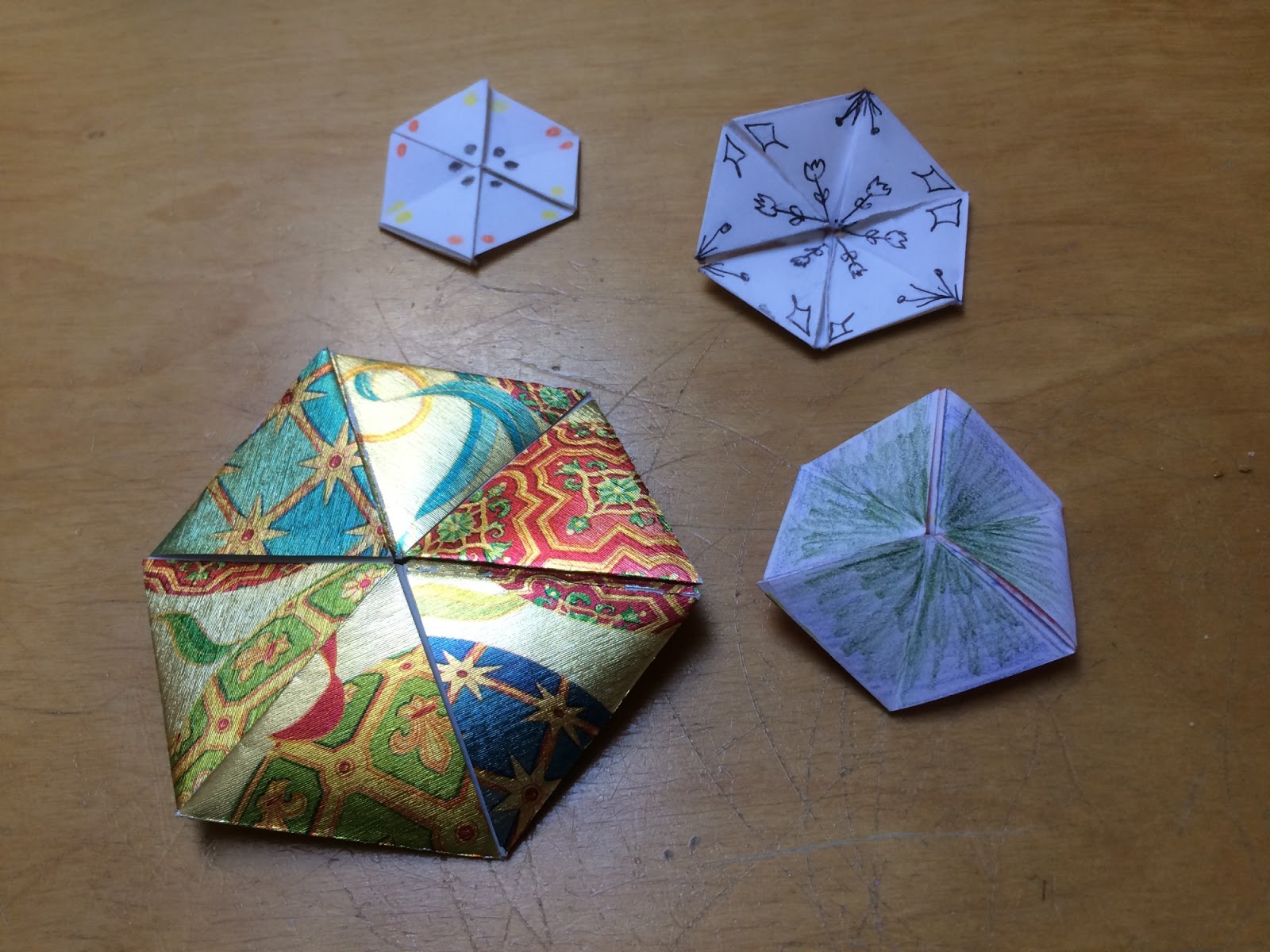
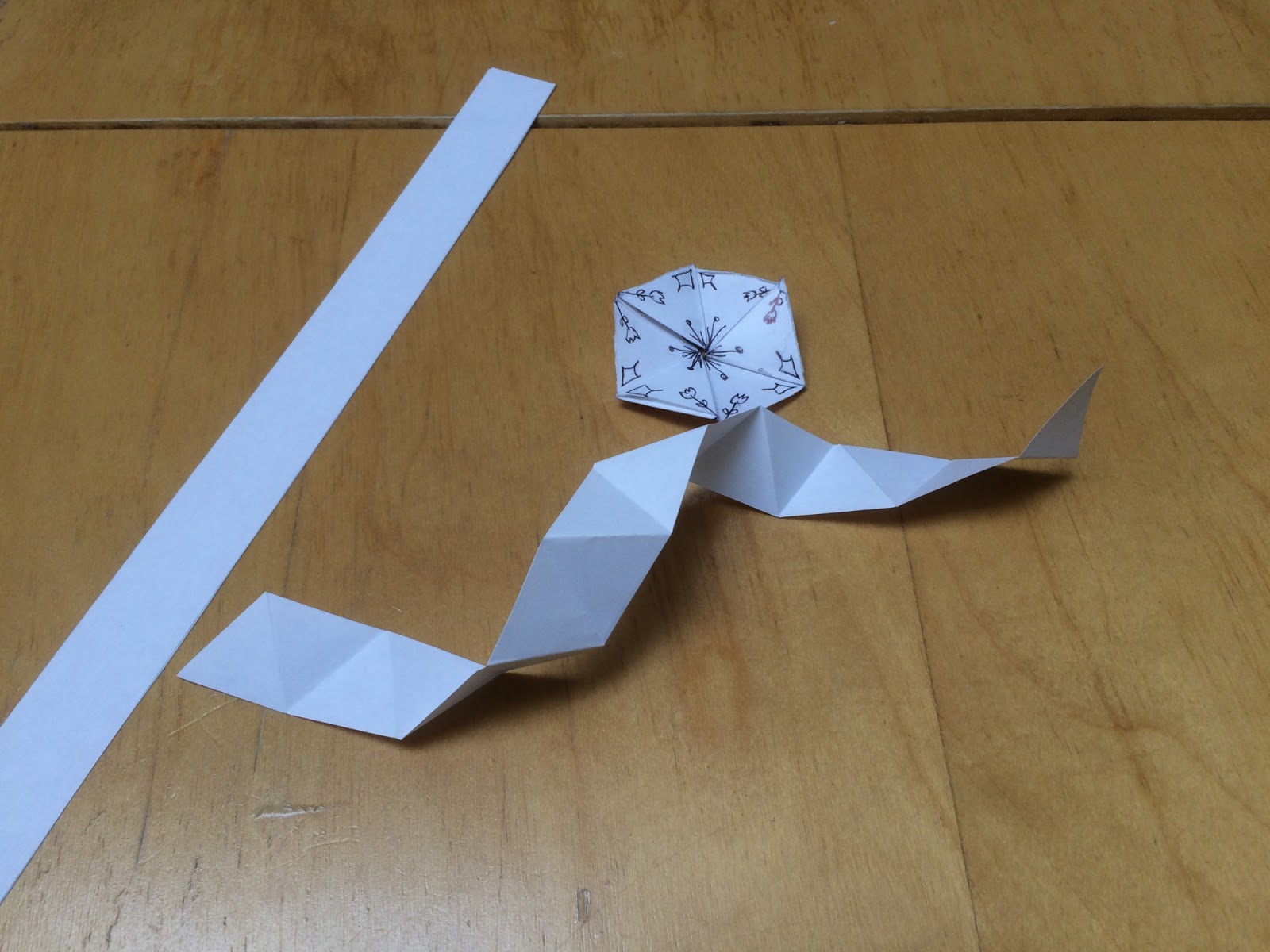
What brought all this to mind was my daughter’s showing me a hexahexaflexagon that a friend of hers had made. She was trying to remember how to fold one from a strip of paper. The first problem was how to get a series of equilateral triangles—she was sure there was a trick to it, and she was right. When she consulted her friend, she found out that she needed to fold the paper strip at an angle, trying to match edges in the same sort of way one folds a letter into thirds.
Having learned all this, she pointed me to a good (and entertaining) Youtube video. (I had been vainly trying to fold an equilateral triangle.) I was able to make my own hexahexaflexagon, and it occurred to me that this is a good party trick of the sort I mentioned earlier. It’s a bit like making a paper crane, but instead of leaving your audience (victim?) with a decorative sculpture, you leaving them madly flexing a hexagon, trying to find all the sides and looking baffled when a new one pops up after they thought they had found them all.
Hexahexaflexagons, one made of shiny wrapping paper
Hexahexaflexagons, one made from wrapping paper.
So there’s my early New Year’s recommendation—figure out what your party trick is, and if necessary, refresh your memory of it. Clearly I need to do so, since my cranes have been coming out deformed, my poems incomplete, and after a year of “frozen shoulder”, I’m out of practice at even the most limited juggling. Maybe I should get into hexahexaflexagons instead…
strip of paper folded ready for making a hexahexaflexagon
Hexahexaflexagon in process
Till next post.
P.S. The same friend who showed her the hexahexaflexagon also gave her a photocopy of a chapter from a book detailing the history of hexaflexagons and some of their properties. The most important bits are also revealed in the Youtube video series of hexaflexagons by Vihart, esp. “Hexaflexagons 2” which I HIGHLY recommend to anyone who wants to create one, and even those who don’t.