Maps, Mystery, and Adventure—decorating with story


I have a pair of porcelain mugs decorated with antique map designs, and an out-of-date globe. What is it about maps, both real and fictional, that makes them so appealing as decoration?
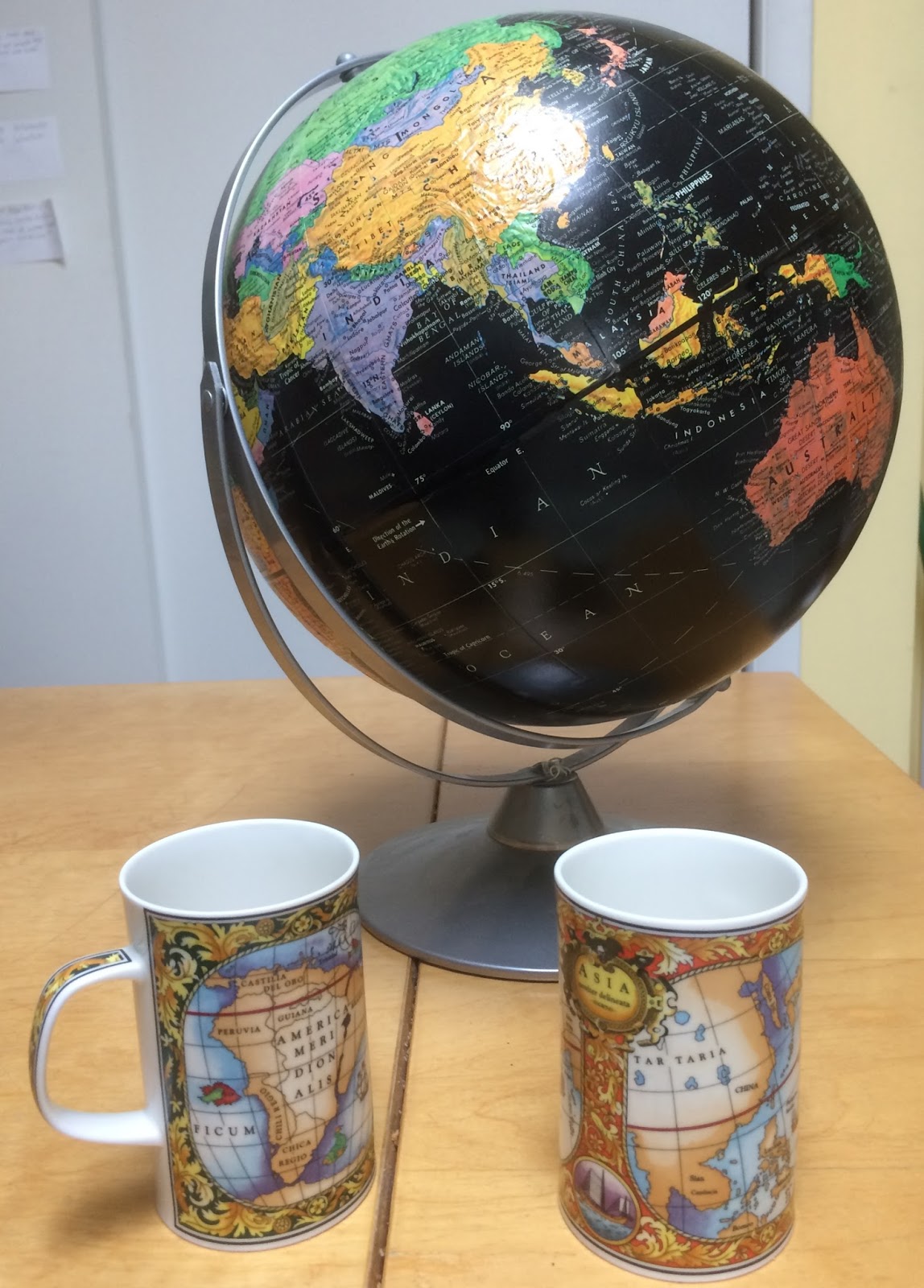
two mugs decorated with antique maps and an out-of-date globe
Decorative maps (globe used to be current)
Some maps are intended to be almost purely functional—the paper road maps in my car (still!) are like that. I have seen even these maps used for decoration, especially if they depict a familiar area (e.g. get a mug with a partial map of your hometown on it), but generally maps tend to be less functional as they get more decorative.
But why decorate something with a map rather than, say, flowers or cars or an abstract design?
Maps show us worlds. Worlds that are, worlds that used to be, and worlds that never were, except in imagination. The right kind of map suggests travel, stories, and adventures. Antique maps, with their limitations and inaccuracies, recall a time when the world was a mysterious place and explorers really didn’t know what they would find. There might be sea serpents, golden cities—even buried treasure, where x marks the spot. In fantasy novels, maps show a world that may really have all those things. Maps are sufficiently popular in fantasy that someone even designed a spoof of fantasy novel maps.
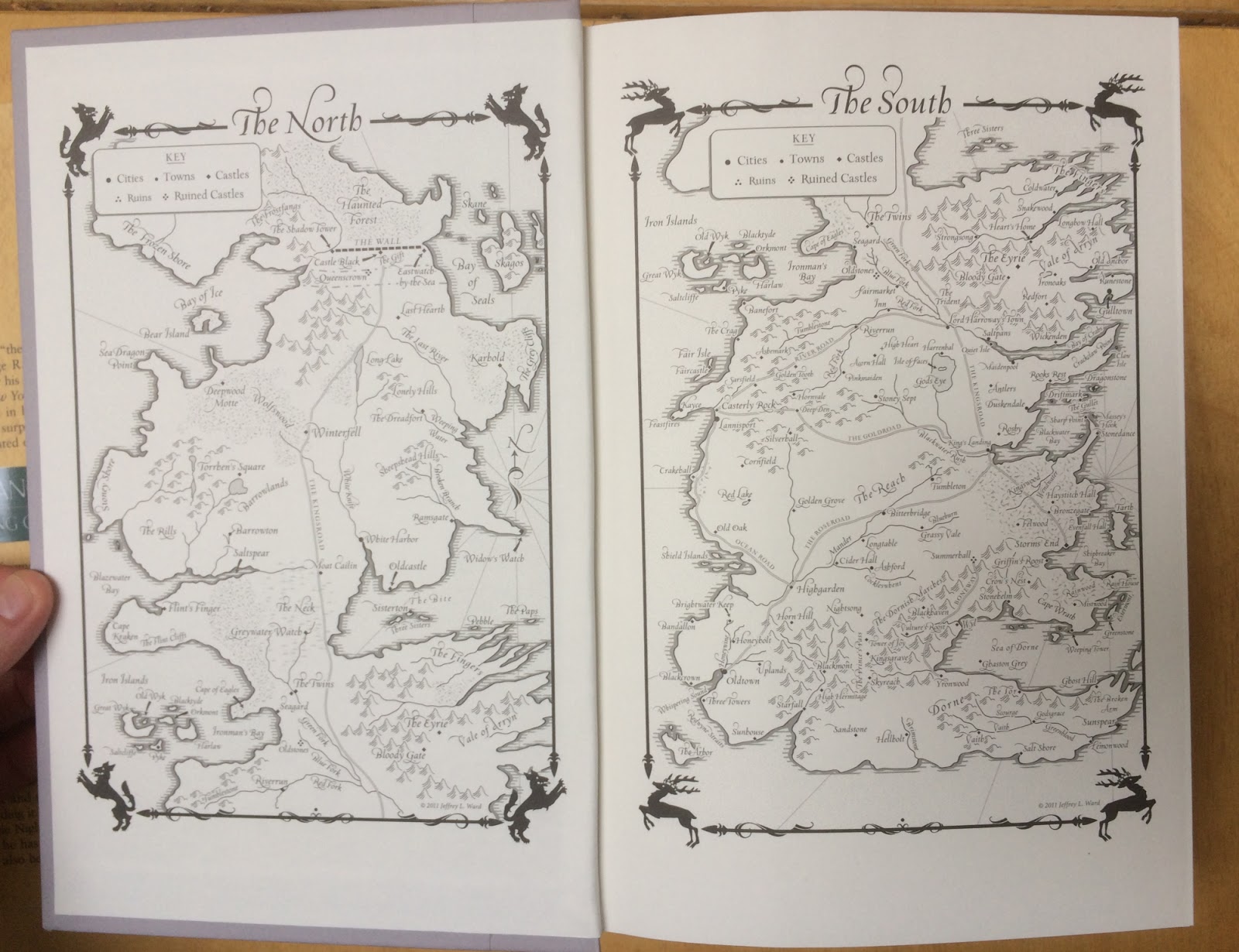
photo of westeros map
Westeros, from Game of Thrones (rather than using Middle Earth as an example)
Maps in mystery novels have a quasi-functional use. A house plan can help the reader track who was where and when–and how a secret passage might have allowed someone to be where they supposedly weren’t. In her mind’s eye, she can see different possible scenarios suggested by the layout of the mystery’s setting.
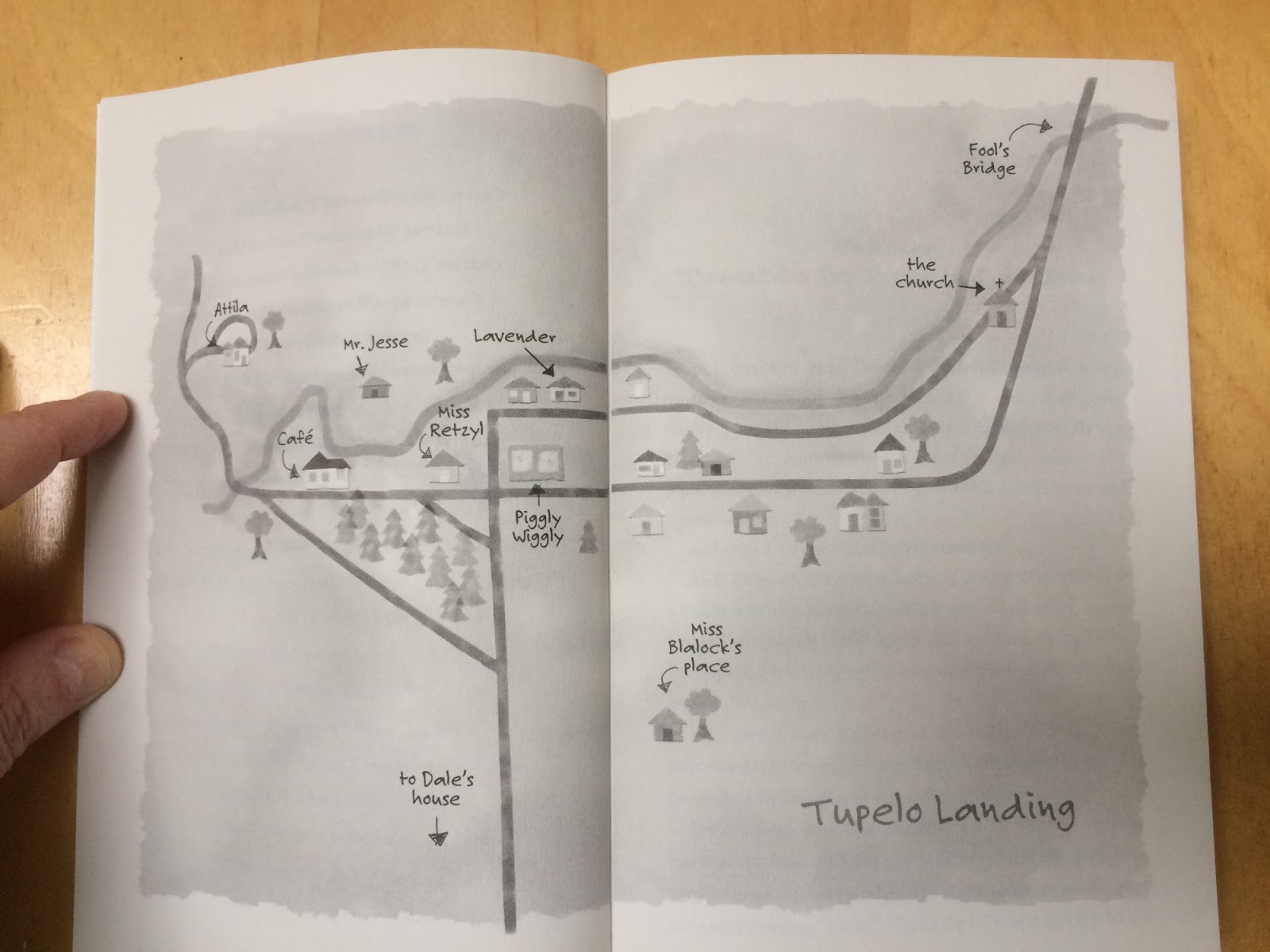
photo of tupelo landing map
Tupelo Landing, from Three Times Lucky by Sheila Turnage
Maps of the world we know don’t have to be purely functional, or even functional at all. Consider the maps that are sometimes designed as souvenirs of a town, where streets aren’t to scale and landmarks are amusingly caricatured. They’re fun, decorative, and sometimes sentimental, but hardly something that will help you navigate, if you should find yourself without GPS and Googlemaps.
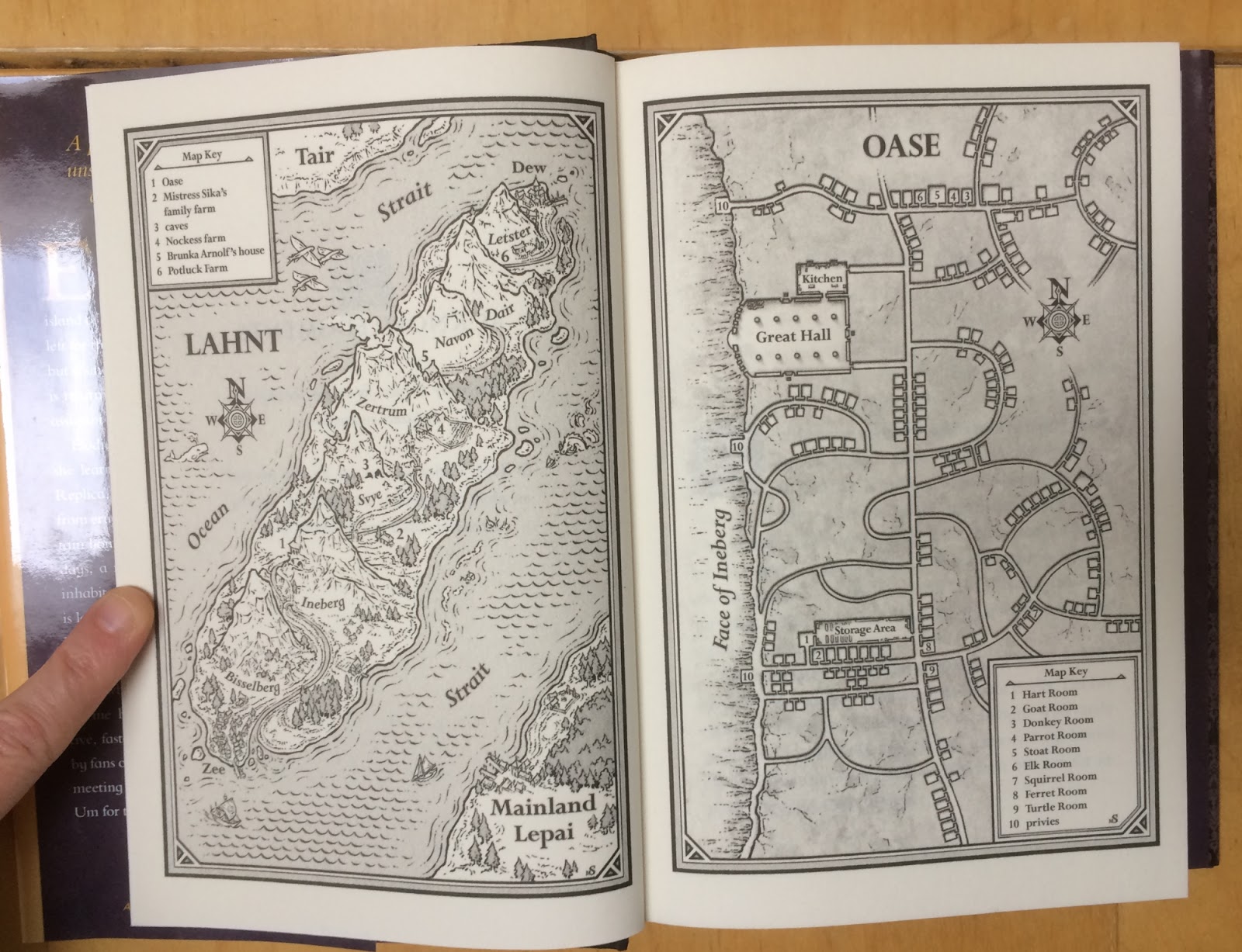
photo of map from Stolen Magic
Stolen Magic by Gail Carson Levine–fantasy and mystery both
In A Great Reckoning, by Louise Penny, an old orienteering map features heavily. But it isn’t a straightforwardly practical map—its maker clearly intended it to refer to landmarks in someone’s personal history. The map isn’t shown in the book, but it is described at various points.
“At first glance, it didn’t look like a map at all. While worn and torn a little, it was beautifully and intricately illustrated, with bears and deer and geese placed around the mountains and forests. In a riot of seasonal confusion, there were spring lilac and plump peony beside maple trees in full autumn color. In the upper-right corner, a snowman wearing a tuque and a habitant sash, a ceinture fléchée, around his plump middle held up a hockey stick in triumph.” (p. 35)
“Yes, it took a while to see beyond all that, to what it really was, at its heart.
A map.
Complete with contour lines and landmarks. Three small pines, like playful children, were clearly meant to be their village. There were walking paths and stone walls and even Larsen’s Rock, so named because Sven Larsen’s cow got stuck on it before being rescued.
Gamache bent closer. And yes, there was the cow.” (p. 36)
Finally, there is something intriguing about the names on a map, not just the images. Some place names are more interesting than others, and just giving an area a name somehow makes it special. Years ago, my daughter and I were at Great Wolf Lodge, a kind of hotel/amusement/water park. The hotel was set up so that the halls could be part of a game in which kids roamed around with electronic “wands”, which when waved at various items, caused them to do something or display something. In keeping with the magical theme, the halls and public areas of the hotel had names.  I should have written some of them down, but I think they were along the lines of “The Enchanted Forest” and such. I commented to my daughter that we should name the areas of our home something more interesting than “Hall Bathroom” and “Mom’s Study.”
(I did in fact name one area of our yard “The Fairy Garden”, and another area that happened to get planted in rosemary, lavender, chives, catmint, and butterfly bush, “The Purple Garden”.)
Having said all this, it is a curious truth that I have not had much luck making maps for the stories that I write. I have some general diagrams to help me keep straight left and right, north and south—but that’s about as far as it goes. And yet, I would love to have some pretty maps to illustrate them with. Maybe I’ll give it another try someday, allowing myself to emphasize beauty  and mystery rather than detail.
Here there be dragons.
Till next post.
On Communicating With the Government–I ponder different methods as I write to the FCC


This week there was considerable fuss, first about the FCC’s proposal to repeal the net neutrality rules, and then about the emails they received in response—in particular, those emails that appeared to have false or temporary addresses or to have originated from Russia. This started me thinking about our communications with our government more generally. Since we are usually communicating with our legislators about bills (rather than sending comments to the FCC), I’m just going to talk about that.
The point of communicating with your congressperson is to influence his/her decisions and change his/her behavior. There are three ways a communication (letter/email/call/visit) could do this.
(1) The content of the communication could be reasons for or against the bill in question.
(2) People’s communications could arrive in such profusion that it causes chaos and makes it impossible for the legislator to ignore the fact that people are concerned about the bill, and maybe also impossible to conduct the rest of his/her business.
(3) The communications could give evidence of grassroots opinions—that many people are very concerned about the bill.
The first possibility, that the communications will give the legislator reasons to change his/her mind, seems fairly unlikely. Probably by that point, he/she has already heard most of the reasons given by both sides, has made up his/her mind to some degree, and isn’t likely to even see, let alone be influenced by, any single communication. (Other people are opening the mail and answering the phone anyway, especially if the legislator is getting tons of mail and phone calls.) Still, that doesn’t mean the communication doesn’t need to offer any reasons. If nothing else, it will give the office workers who tally people’s positions a general sense of people’s reasons.
The second possibility, that the sheer volume of communications is what matters, suggests that politics is a matter of beating your legislator into submission, which is a pretty cynical view of things, though maybe with a grain of truth to it. Maybe we want the letters to be disruptive enough to get the legislator’s attention, but surely not so much that it prevents him/her from doing other useful things, or thinking about other forthcoming bills. Otherwise legislators won’t be able to do anything most of the time, and why would we want that?
The third possibility seems the strongest. If lots of people hold a particular opinion on a bill and hold it very strongly, then not only should the legislator, as representative, be concerned about representing their view, but the legislator’s vote on the bill could have an effect on his/her chances of re-election. And that’s a powerful motivator.
How much is his/her vote on the bill likely to affect his/her re-election? Well, how many people are for it, and how strongly do they feel? Both matter. If lots of people support the bill but only lukewarmly, the legislator could probably get away with voting against it. If only a few people support it, it doesn’t matter how much they care, they still only have a few votes to give.
So what kind of evidence do the various forms of communication give of these things? Long ago, when I was an intern in Congressman Whitehurst’s office*, I was given the relatively unimportant job of looking up the addresses of people who had signed their names to form postcards. Form postcards were, I think, supplied by political organizations and probably dropped off by them as well—I don’t think the individuals who signed the cards had to actually mail the cards themselves. But they did have to sign their names and maybe give their town. I was to look up the full addresses so the office could send them a form letter in response.
Remember, this was before most people had personal computers, and well before there was a world wide web. No cutting and pasting letters (except in the very literal sense) and no email. So there were form postcards, regular letters, phone calls (long distance was still expensive), and personal visits. Form postcards were the least important, because they took the least effort and expense on the part of the sender.
Now emails make communicating with your legislator easier, but as this week’s kerfuffle makes clear, there is the problem of knowing whether the email represents a particular individual, or if it has been sent by a bot, or if one individual or sneaky organization has sent many emails, and whether the sender is even an American and eligible to vote.
On top of that, emails can be sent with very little effort, especially if they are pre-written and addressed by an organization, so that the individual has only to enter his or her email address and click a button. So the emails don’t do a good job of showing just how much the sender cares about the issue. Is this a make-it or break-it issue for them, or just one among many concerns?
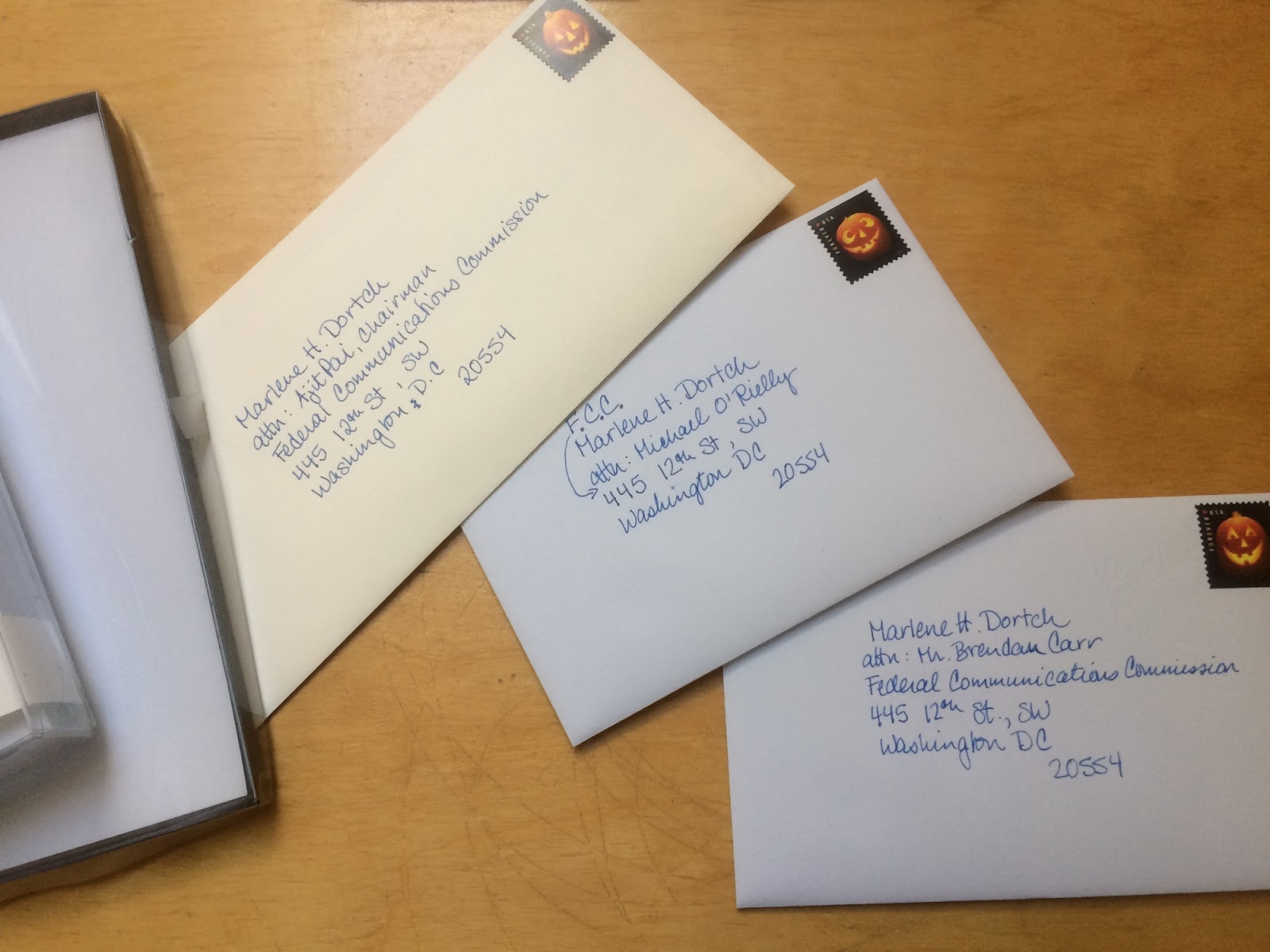
So I’m sending the FCC chairman and commissioners hand-written letters that will arrive with my local postmark on them. I doubt hand-written letters are a solution long-term. If people take to writing their letters by hand, some sneaky group may find a way to fake them. On the other hand, it costs 49 cents apiece to mail them, so maybe no organization will find it worth the money.
Hand addressed envelopes to commissioners of the FCC
On reflection, I should have sent a single letter to the FCC in general.
Till next post.
*I was politically apathetic in high school, but we were required to intern in a congressional office junior year. I had no idea where to start, so I took the suggestion of the program director and asked to intern in G. William Whitehurst’s office. They were lovely people, but I don’t remember ever actually trying to find out what their positions on any issues were. I’m not sure what most of the issues of the day even were, other than nuclear arms policies. I find it funny now, to think that I, who even then counted myself at least vaguely a Democrat, did my internship in a Republican’s office. I really had no idea what I was about. Fortunately, they were very patient. 

Sparkle, Shine and Scarcity


And now back to shiny things…
Because the story I am writing involves the theft of a fabulous ruby necklace, I have been reading books about jewelry. One very entertaining book, Stoned: Jewelry, Obsession, and How Desire Shapes the World by Aja Raden, focuses on the role of gems in history.
I had heard the story about DeBeers and “A diamond is forever” before—even before my daughter informed me that Adam, who Ruins Everything, had ruined diamonds for her. Stoned provided more details: the relative unimportance of diamonds early in our history, the difference that improved cutting techniques made, and the way that DeBeers turned them into something everyone wanted with clever advertising and choke-hold on the supply.
I hadn’t heard the story about Spain flooding Europe with New World emeralds and drastically reducing the value of their own crown jewels. Nor had I realized just how scarce, and prized, pearls once were.
The relationship between scarcity and value is interesting. I am sometimes amazed at the things we can create now—the materials, the finishes, the new techniques. Beautiful things are widely available to us. In fact, we fail to notice quite how many treasures we have because they are so very available and cheap.
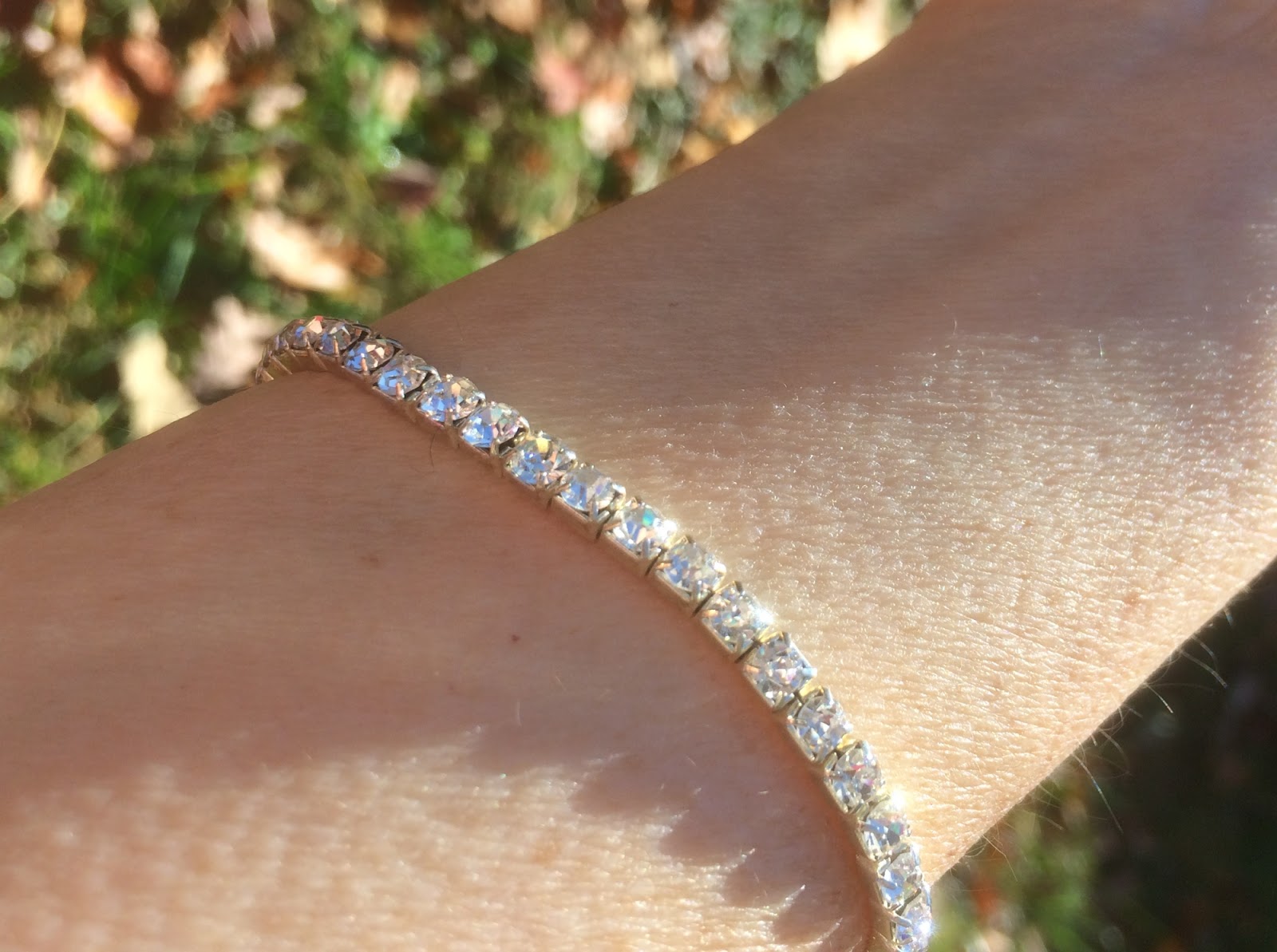
For example, I have a bracelet I like–stretchy, silvery, and glittering. Now, my mom isn’t into jewelry. She has very little of it herself and no idea what is currently in stores. She saw me wearing the bracelet and asked when I’d gotten it. From her tone, I think she expected to hear that it was a special anniversary present. Instead, I said, “Six dollars at Walmart.”
Sparkly stretch bracelet glitters like diamond in the sun.
Diamond tennis bracelet or kid’s costume jewelry?
Someone more familiar with today’s little girls would have recognized the style right away… but does that make the bracelet any less beautiful?
It’s not a rhetorical question. If you glance at it, think “cheap costume jewelry”, and look away… certainly you appreciate it less. But I think it’s fabulous. I hold my wrist up to the sun and watch it glitter. It isn’t durable (I’ve broken the stretchy cord on several already) but it is pretty. And what attracted humans to gems in the first place, if not their color, translucence, and sparkle?
And the bracelet is just the beginning! Little girls’ wardrobes are full of sparkle and shine that I would have begged for as a child, had it been available. (I did have shiny black patent leather shoes…)
We also now have the ability to synthesize precious stones—rubies, sapphires, diamonds. They are no less attractive for having been made in a lab, and there are many more of them to go around. Apparently some fancy watches have a crystal (the glass front of the watch) made of colorless synthetic sapphire! Imagine that—they can make a cylinder of synthetic sapphire wide enough for a watch face, and then slice off pieces of it. What else can they do?
Well, they can make a diamond ring. That is, a ring made of diamond, not a ring set with a diamond. It sounds like the sort of thing you’d find in a Richie Rich comic book. I couldn’t find out whether the diamond was natural or synthetic, but it seems like an odd and perhaps even wasteful way to cut a large diamond, which makes me think maybe it was synthetic.
It isn’t just gems that are shiny and beautiful and increasingly available. When I was in my teens, I bought postcards with what we would now call “holographic foil” on them at a science museum. I paid at least four times what regular postcards cost—maybe it was more than that. They were special! I taped them up on my wall for my friends to admire. Now I throw away used Christmas wrapping that would put those postcards to shame.
I could give further examples, but you get the idea. We have shine, glitter, and vivid colors enough for old-fashioned royalty.* Do we feel like royalty? Apparently not—everyone else is just as shiny, glittery, and colorful as we are.  And yet…wow.
Just…wow.
Till next post.
*Admittedly, we’re a little short on actual gold—never found that Philosopher’s Stone—but we have a lot of really good gold-colored paint and foil.